

Spousal Sponsorship Canada 2026
Canada’s spousal sponsorship program is a Family Class stream designed to support family reunification. Spousal sponsorship applications fall into three relationship categories—spouses, common-law partners, and conjugal partners—which guide how Immigration, Refugees and Citizenship Canada assesses eligibility and relationship genuineness. These categories apply equally to opposite-sex and and LGBTQ+ couples.
To begin, the sponsor must meet eligibility requirements, submit the required application forms and supporting documents, and accept the financial obligations of the sponsorship undertaking. The couple must demonstrate a genuine, ongoing relationship supported by credible and well-documented evidence.
Couples may apply through either the inland or outland process, depending on where the sponsored partner resides. Inland applicants who are already in Canada may be eligible to apply for an Open Work Permit while their sponsorship application is in process. Outland applicants may apply for a Visitor Visa to visit Canada during processing, if eligible.
The process involves submitting the application and government fees, followed by IRCC completeness checks, background and security screening, and admissibility assessments. Biometrics and an immigration medical examination are required for the sponsored person. Average processing times are at least 12 months, though timelines vary depending on case complexity, the applicant’s country of residence, and IRCC workload. Applicants can track the progress of their permanent residence applications online.
Applications may be refused due to insufficient proof of a genuine relationship, incomplete documentation, or inadmissibility concerns. Outland refusals may be appealed to the Immigration Appeal Division.
A well-prepared application can help reduce delays and minimize the risk of refusal. Our Canadian immigration consultants assist clients at every stage—from eligibility assessment to a complete, well-organized submission. Between 2023 and 2025, we assisted over 1,200 couples with their sponsorship cases. For personalized guidance, you can book an initial consultation with one of our specialists. You may also review our Immigration Consultant fees for a clear overview of our services.
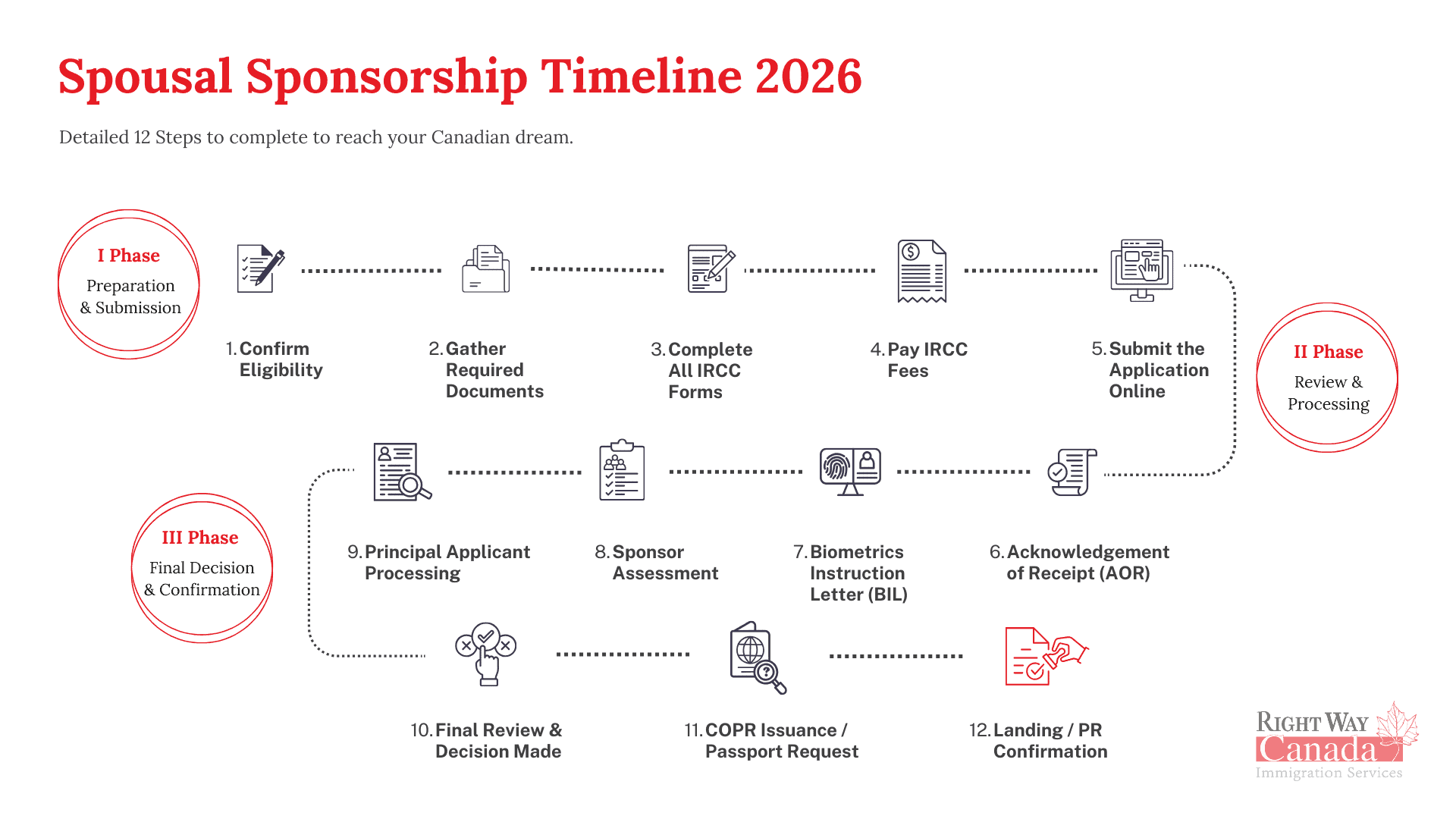
Spousal SponsorShip Application Timeline
How Long Is the Spousal PR Process?
The spouse PR timeline is a top concern for every couple. While exact timelines vary based on the applicant’s country of residence, visa office, and case complexity, most straightforward applications follow these averages:
- Outland: ~ 10–12 months
- Inland: ~ 12–24 months
- Complex cases, background/security delays, or certain regions may take longer.
It is normal to experience long periods with no visible updates, especially during background checks.
Step 1: Confirm Eligibility
- Sponsor meets Canadian requirements.
- Applicant meets admissibility criteria.
- Choose the correct application type:
- Inland (may allow for a Spousal Open Work Permit — SOWP)
- Outland
Taking the time to confirm eligibility at the beginning helps avoid returned applications, refusals, and unnecessary delays. This step ensures you choose the correct stream and move forward with confidence before preparing the full application package.
Step 2: Gather Required Documents
- Police Certificates: Must be issued within the last 6 months before submission to avoid expiration and delays.
- Medical Exam: Do not complete an upfront medical unless IRCC specifically instructs you to. Medicals are valid for 12 months, and most applications exceed this timeframe – meaning you may need to repeat (and pay for) another exam.
- Relationship evidence, forms, photos, passports, and country-specific documents.
Step 3: Complete All IRCC Forms
Ensure all signatures, dates, and required fields are complete to avoid a returned application.
IRCC forms must be completed accurately and consistently across all sections. Even small errors, missing signatures, or mismatched information can result in the entire application being returned, causing significant delays. Taking time to carefully review each form before submission helps ensure the application moves forward without interruption.
Step 4: Pay IRCC Fees
Includes sponsorship fee, biometrics fee, and right of permanent residence fee (RPRF).
Paying all required fees upfront is recommended to prevent processing delays later in the application. If the right of permanent residence fee (RPRF) is not paid at submission, IRCC will request it later, which can slow final approval. Always keep copies of payment receipts as proof for your records.
Step 5: Submit the Application Online
Please ensure all forms are electronically signed, your document checklist is complete, and your processing fees have been paid. Once submitted, you cannot edit your application.
It is important to review the entire application carefully before clicking submit. Double-check uploaded documents, signatures, and payment confirmations to ensure everything is accurate and complete. A final review helps reduce the risk of delays caused by errors or missing information.
Step 6: Acknowledgement of Receipt (AOR)
1–3 months after submission
You receive confirmation that:
- The application is in processing
- A file number is assigned
- You may now apply for the SOWP (Inland applicants), which typically takes 1–4 months to process
Step 7: Biometrics Instruction Letter (BIL)
Month 3–4
- IRCC requests biometrics, usually early in the process.
- Even if biometrics were recently given for a visa, a new set is often required for the PR file.
After receiving the Biometrics Instruction Letter, the applicant must book and complete biometrics at an authorized collection centre within the required timeframe.
Step 8: Sponsor Assessment
Month 3–5
IRCC evaluates the sponsor’s eligibility.
If approved, IRCC issues the Sponsor Approval (SA) letter.
During this stage, IRCC reviews the sponsor’s status, financial obligations, and past sponsorship history to confirm eligibility before moving the application forward.
Step 9: Principal Applicant Processing
Months 4–10
After sponsor approval, IRCC assesses the applicant’s eligibility.
Medical Exam Request (IMM 1017): Issued if no upfront medical was completed.
Background Checks: Criminality, security screening, and information sharing.
Eligibility Review: Relationship genuineness and supporting documentation.
Additional Requests: Updated police certificates, extra evidence, or—rarely—an interview if concerns arise.
Step 10: Final Review & Decision Made
Month 11–12
IRCC confirms that all of the following have passed:
- Eligibility
- Medical
- Criminality
- Security
Step 11: COPR Issuance / Passport Request
2–4 weeks after Decision Made
Inland Applicants:
- Receive an email to access the PR Confirmation Portal.
- Complete online steps to confirm presence in Canada.
Outland Applicants:
- Receive Passport Request (PPR) or Ready for Visa (RFV) instructions.
- Submit passport for counterfoil visa and receive your paper COPR.
Step 12: Landing / PR Confirmation
- Outside Canada:
Land at a Canadian airport or land border with your COPR. - Inside Canada: Confirm via the online PR portal → receive eCOPR → PR card is mailed.
This step officially finalizes permanent resident status. Once landing is completed or eCOPR is issued, the applicant becomes a permanent resident of Canada and can begin exercising PR rights while waiting for the physical PR card.
Can I Sponsor My ——– to Canada?
PR for Spouse
Applying for a marriage visa through Canada’s spousal sponsorship program is one of the most reliable pathways for couples who want to build a stable life together. Whether you are pursuing wife sponsorship or husband sponsorship, the process requires proving a genuine marriage, meeting all IRCC requirements, and submitting strong documentary evidence. Because marriage immigration in Canada must reflect a real relationship, officers review each file carefully and may schedule a marriage interview if they need more details.
When you submit your sponsorship application, both spouses must complete biometrics, a medical exam, and police certificates. The Canadian sponsor must also sign a three-year undertaking, similar in responsibility to a contract marriage, agreeing to provide financial support once the spouse becomes a permanent resident. This undertaking is legally binding, and the sponsor remains financially responsible for their spouse for 3 years, even if the couple divorces, separates, the spouse loses their job, or receives social assistance. If the sponsored partner does receive welfare, the sponsor must repay the government.
Couples can apply from inside Canada as well as from outside the country.
Inland processing: available when both partners are living together in Canada and may allow the sponsored spouse to receive an open work permit while waiting.
Outland processing: required when the spouse is living outside Canada and can sometimes be faster depending on the visa office.
During the review, IRCC may request an immigration letter where you outline your relationship history so the officer can better understand your marriage.
Completing a successful marriage sponsorship application requires strong organization, accurate paperwork, and clear proof that the partnership is genuine. With proper guidance and well-prepared evidence, spouse sponsorship remains one of the most reliable ways for married partners to reunite in Canada and build a secure, long-term future together.
PR For Common-law partner
Common-law partner sponsorship is for couples who are not married but have lived together in a committed, marriage-like relationship for 12 consecutive months (short, temporary absences are allowed). To qualify, you must prove a full year of continuous cohabitation before applying—this is especially important for outland cases—and inland applicants generally must be living in Canada with valid temporary status (unless exempt under a public policy).
Because common-law couples don’t have a marriage certificate, IRCC expects strong evidence of shared residence and an interdependent life (for example, joint leases/bills, shared finances, and consistent proof of living together). Processing is typically around 12 months, and the sponsor signs a 3-year undertaking once the partner becomes a permanent resident.
PR For conjugal partner
Conjugal partner sponsorship is a Family Class option for couples in a committed, marriage-like relationship who cannot marry or live together due to serious barriers (such as legal restrictions, immigration constraints, or safety concerns). Couples must generally show the relationship has been genuine and ongoing for at least 12 months and provide strong proof of both the relationship and the barriers that prevent marriage or cohabitation.
Only Canadian citizens (including those abroad who plan to return) and permanent residents living in Canada can sponsor, and the sponsor signs a 3-year undertaking. This stream is outland only, typically takes 12–18 months or longer.
PR For Same-Sex Marriages & LGBTQ+ Couples
Canada allows LGBTQ+ couples to apply for spousal sponsorship under the same rules as opposite-sex couples. Partners may qualify as married spouses (including marriages performed abroad if legally valid where they took place), common-law partners after 12 months of living together, or conjugal partners when serious barriers make marriage or cohabitation impossible.
Some LGBTQ+ couples face added challenges—such as discrimination or safety risks, limited public documentation, difficulty cohabiting, or visa refusals. These issues don’t prevent sponsorship, but they often require clear explanations and alternative evidence to support the relationship and any barriers. Couples can apply inland if the partner is already in Canada or outland if the partner is abroad or travel/cohabitation isn’t feasible, with processing generally following standard spousal sponsorship timelines.
PR For fiancé/Fiancée
Canada does not have a fiancé visa, so being engaged alone does not make someone eligible to immigrate. Instead, couples must qualify under an existing family sponsorship category before applying for permanent residence. Engaged couples usually consider three options:
- Spousal sponsorship: marry first, then apply as spouses (the closest alternative to a fiancé pathway).
- Common-law sponsorship: live together for 12 continuous months and apply as common-law partners.
- Conjugal partner sponsorship: for rare cases where marriage or living together isn’t possible due to serious barriers (such as legal restrictions, immigration limits, or safety concerns).
Processing times are often around a year, but vary by case and IRCC workload. The best option depends on whether you can marry, cohabit, or must prove barriers that prevent both.
Sponsor Your Spouse to Canada: Eligibility & Requirements
Canada’s spouse sponsorship program allows committed couples to build their life together in Canada, but both partners must meet IRCC’s eligibility and admissibility requirements. Understanding these rules early helps prevent delays, strengthens your application, and ensures a smoother process from start to finish. Whether applying inland or outland, the following requirements form the foundation of a successful sponsorship application.
General Requirements
INLAND AND OUTLAND SPONSORSHIP OPTIONS
- For inland applications, the couple must be living together in Canada.
- The sponsored person must have a valid temporary status, qualify for maintained status, or be eligible to apply for restoration.
Learn more about the differences between inland and outland sponsorship.
PROOF OF RELATIONSHIP
A strong application includes clear, consistent documentation showing that your relationship is genuine, stable, and ongoing. Learn more
APPLICATION COMPLETENESS
Your application must include all required forms, documents, evidence, and full payments of fees. Missing or incomplete items can cause delays or lead to the application being returned. Learn more
PROCESSING TIMES
IRCC generally processes spouse sponsorship applications in about 12 months, though timelines vary by application type and visa office workload. Learn more
REFUSALS, APPEALS & NEXT STEPS
If refused, outland applicants may appeal to the Immigration Appeal Division, while inland applicants may pursue judicial review or reapply. Learn more
AFTER APPROVAL
Once approved, after landing, a Permanent Residence (PR) card is issued, and the sponsor’s 3-year undertaking begins.
Understanding IRCC’s requirements for both the sponsor and the applicant helps you prepare a strong and complete submission. Clear documentation and proper preparation give you the best chance of an efficient sponsorship process.
Sponsor Eligibility Requirements
To sponsor your spouse or partner, you must meet all sponsorship requirements set by IRCC.
YOU MAY BE ELIBIBLE TO SPONSOR IF YOU:
- Are 18 years of age or older
- Are a Canadian citizen, permanent resident (PR), or registered Indian under the Canadian Indian Act
- Live in Canada, or (if a Canadian citizen abroad) can prove you will return once your partner becomes a permanent resident (PR)
- Permanent residents must be residing in Canada to sponsor
- Are not receiving social assistance, except for disability
- Can demonstrate the ability to support both yourself and your spouse or partner. IRCC does not require a fixed minimum income for spouse sponsorship, but may review your financial situation if there are concerns about your ability to meet basic needs.
Please note: Sponsorship rules in Quebec are different due to a separate provincial undertaking process.
SITUATIONS WHERE YOU CANNOT SPONSOR
You may not be eligible to sponsor if:
- You were sponsored as a spouse or partner and became a permanent resident (PR) less than 5 years ago.
- You previously sponsored a spouse or partner and are still within the 3-year undertaking period.
- You defaulted on a previous sponsorship undertaking.
- You are in default of court-ordered support obligations (alimony and/or child support).
- You are in default of immigration loans or other government debts. (including transportation loans or assistance loans).
- You are in default of a performance bond.
- You are an undischarged bankrupt.
- You are receiving social assistance other than for disability.
- You are detained or imprisoned (in jail or prison).
- You are under a removal order.
- You have certain criminal convictions, including certain violent or sexual offences against a family member (depending on the offence and circumstances).
Note: IRCC may find a sponsor ineligible for other reasons depending on the specific situation.
Sponsorship Undertaking & Responsibilities
Sponsoring your spouse or partner includes signing a legally binding undertaking that outlines your financial responsibilities once the sponsored person becomes a permanent resident (PR).
Sponsoring your spouse means signing a legally binding undertaking to support them once they become a permanent resident (PR). You must provide:
- Food, clothing, and basic necessities
- Housing and utilities
- Essential household items
- Health-related expenses not covered by public insurance
This undertaking lasts 3 years, starting on the day your spouse becomes a permanent resident (PR) and cannot be cancelled, even if the relationship ends.
Applicant Eligibility Requirements
The person being sponsored must also meet IRCC’s eligibility and admissibility requirements to qualify as a spouse, common-law partner, or conjugal partner.
WHO CAN BE SPONSORED
Your spouse or partner must:
- Be 18 years of age or older
- Be legally recognized as your spouse, common-law, or conjugal partner
- Be in a genuine, ongoing, and committed relationship with you
RELATIONSHIP GENUINENESS
IRCC must be convinced your relationship is genuine and not for immigration purposes. Officers assess your relationship, including:
- How/ when you met
- How the relationship progressed
- Emotional and financial support
- Time spent together
- Communication patterns
- Family involvement
- Long-term plans as a couple
Common relationship evidence includes:
- Photos
- Travel records
- Joint bills (utilities, phone plans, internet)
- leases, or bank accounts
- Chat logs, call histories, and emails
- Letters from family and friends
- Proof of visits
- Children’s birth certificates (if applicable)
- Joint insurance (health, auto, life, tenant)
- Joint memberships or subscriptions
Factors like age differences, cultural differences, or limited cohabitation are not automatic refusals, but they require stronger supporting evidence.
ADMISSIBILITY REQUIREMENTS
Your spouse or partner must also be admissible to Canada.
Medical: They must complete an approved medical exam.
Criminality: Police certificates are required. Certain convictions can cause inadmissibility unless rehabilitation or a TRP is available.
Security: IRCC performs background and security checks.
Misrepresentation: Providing false or incomplete information can lead to refusal and a 5-year ban.
Accompanying Child
Dependent children can be included in the sponsorship application as accompanying (immigrating now) or non-accompanying (declared but not immigrating at this time).
WHO QUALIFIES AS A DEPENDENT CHILD
A child may qualify if they:
- Are under 22 and not married/common-law, or
- Are 22+ and financially dependent due to a physical/mental condition (with dependency starting before 22)
Age lock-in: IRCC fixes the child’s age eligibility on the date a complete application is submitted.
Important notes
- All children must be declared, even if not immigrating now. Not declaring a child can lead to refusal or prevent future sponsorship.
- Children usually need medical exams and supporting documents (e.g., birth certificate, passport, custody/consent documents if parents are separated).

Country-Specific Requirements
Every year, Canadians sponsor spouses from all over the world, and some countries appear far more frequently in spousal sponsorship applications. While the core IRCC requirements are the same for all applicants, many countries also have country-specific documents or authentication rules that couples must follow. Search below for country-specific spousal sponsorship requirements available for 170+ Countries.
- India
- Philippines
- United States (US)
- China
- Pakistan
- Mexico
- Vietnam
- Jamaica
- Nigeria
- United Kingdom (UK)
- Eritrea
- Haiti
- Iran
- Ethiopia
- Lebanon
- Brazil
- France
- Colombia
- Afghanistan
- South Korea
- Bangladesh
- Cameroon
- Sri Lanka
- Hong Kong
- Morocco
- Cuba
- Australia
- Ghana
- Algeria
- Somalia
- Japan
- Syria
- Dominican Republic
- Taiwan
- Egypt
- Germany
- Congo
- Tunisia
- Turkey
- Russia
- Jordan
- Iraq
- Ivory Coast
- Ukraine
- Nepal
- Thailand
- Italy
- Guyana
- Ireland
- Portugal
- Peru
- Chile
- Senegal
- El Salvador
- Trinidad and Tobago
- New Zealand
- Spain
- Poland
- Netherlands
- Ecuador
- Israel
- Rwanda
- Indonesia
- Sudan
- South Africa
- Venezuela
- Burundi
- Guinea
- Albania
- Guatemala
- Uganda
- Sweden
- Palestinian Authority (Gaza)
- Palestinian Authority (West Bank)
- St. Vincent and the Grenadines
- Honduras
- Yemen
- Malaysia
- Romania
- Costa Rica
- Cambodia
- Argentina
- Belgium
- Greece
- Togo
- St. Lucia
- Mali
- Nicaragua
- Kosovo
- Barbados
- Serbia
- Burkina Faso
- Mauritius
- Zimbabwe
- Bolivia
- Tanzania
- Benin
- Kazakhstan
- Georgia
- Singapore
- Libya
- Switzerland
- Bahama Islands
- Czechia
- Djibouti
- Hungary
- Fiji
- Uzbekistan
- Antigua and Barbuda
- Croatia
- Grenada
- Armenia
- Australia
- Norway
- Azerbaijan
- Gambia
- Belarus
- Sierra Leone
- Myanmar(Burma)
- South Sudan
- Liberia
- Chad
- Denmark
- Panama
- Saudi Arabia
- Finland
- Paraguay
- Macedonia
- Latvia
- Bulgaria
- Slovakia
- Mongolia
- Mauritania
- Bosnia-Herzegovina
- Angola
- Zambia
- Uruguay
- Madagascar
- Lithuania
- Kyrgyzstan
- Moldova
- Belize
- Dominica
- Namibia
- Laos
- Niger
- Gabon
- Tajikistan
- Malawi
- Montenegro
- Central African Republic
- Estonia
- Iceland
- Slovenia
- Saint Kitts and Nevis
- Botswana
- Macau
- Kuwait
- Cyprus
Special Cases and Key Challenges
Arranged Marriages
Arranged marriages can be accepted for Canadian spousal sponsorship as long as the marriage is legally valid and the relationship is genuine (not entered into mainly for immigration purposes). IRCC does not refuse applications simply because a marriage was arranged—officers assess it like any other marriage by looking at the relationship history, consistency of your answers and documents, and whether the relationship is stable and ongoing.
The key is showing free, informed consent and real-life commitment after the match. Strong evidence often includes a clear relationship timeline, ongoing communication, in-person visits, wedding and post-wedding documentation, family involvement where relevant, and proof of shared plans and support (financial, emotional, and practical). If there are risk factors—such as limited time together, living apart, or cultural differences—providing stronger, more objective documentation becomes even more important. Forced marriages are not accepted. Learn more
Minimum Income Requirements
There is no minimum income requirement to sponsor a spouse, common-law, or conjugal partner in Canada in most cases. Instead, IRCC checks that the sponsor can meet basic needs and is not receiving social assistance (except for disability). While there’s no set income threshold for typical spousal sponsorships, IRCC may still review your overall financial situation if there are concerns about your ability to support the sponsored person.
A minimum income requirement applies only in limited situations, such as when the sponsored spouse or partner has a dependent child who has their own dependent child. Quebec also follows different rules and requires a separate provincial undertaking process with its own financial assessment. Learn more
Refusals and Appeals
If your spousal sponsorship is refused, you may still have options to appeal, request judicial review, or reapply—depending on the refusal reasons and whether you applied outland or inland.
Many outland (Family Class) refusals can be appealed to the Immigration Appeal Division (IAD), where you may be able to submit additional evidence and explain the relationship in more detail. In contrast, many inland refusals do not come with a full appeal right and may require judicial review at Federal Court, which focuses on whether the decision was reasonable and procedurally fair.
In some situations, the most practical path is to reapply with a stronger application, correcting the issues that led to the refusal—such as missing documents, inconsistent timelines, credibility concerns, weak proof of relationship, or misrepresentation risks. A strong first step is to obtain and carefully review the refusal reasons and decision notes, then rebuild your case based on what IRCC flagged. Learn more
Spousal Sponsorship Interview
Not every spousal sponsorship application requires an interview. IRCC may schedule an interview when an officer needs clarification or additional verification—most often around the genuineness of the relationship, inconsistencies in the forms or evidence, missing details in the timeline, or other eligibility concerns. Interviews are usually requested later in processing once an officer has reviewed the file and decides that an in-person (or virtual) discussion is needed to confirm key facts.
Interview questions typically cover how you met, how the relationship developed, living arrangements, communication and visits, family involvement, finances, and future plans—often comparing each partner’s answers for consistency. A well-organized application with clear, objective relationship evidence can reduce the likelihood of an interview, and good preparation helps you respond confidently if one is required. Learn more
Application Withdrawal or Cancelation
To withdraw (cancel) a spousal sponsorship application, you must send IRCC a clear written request—most commonly through the IRCC webform—asking them to stop processing your file. In your request, include the sponsor and applicant’s full names, dates of birth, UCI(s), application number, and current contact information, and clearly state who is withdrawing (the sponsor, the principal applicant, or both).
You can usually withdraw at any time before IRCC makes a final decision or before the sponsored person becomes a permanent resident. If you used a representative, they can submit the request, but IRCC may still ask for your direct confirmation. Depending on how far processing has progressed, you may be eligible for a partial refund of fees. Learn more
Spousal Sponsorship Application
Inland vs Outland
Inland and outland refer to which spousal sponsorship stream you choose—applying from inside Canada versus through the Family Class processed outside Canada.
Inland sponsorship is usually the right fit when you’re living together in Canada, and it may allow the sponsored spouse or partner to apply for a Spousal Open Work Permit during processing.
Outland sponsorship is often used when the applicant is outside Canada or needs more travel flexibility, and it can preserve a right of appeal if the application is refused.
The best choice depends on where you’ll live during processing, whether the applicant needs to work in Canada, and how important travel and appeal rights are in your situation. Learn More
Document Checklist (complete guide)
You can find the official spousal sponsorship document checklist on IRCC’s “How to apply” pages for the Spouse/Common-law Partner program. IRCC will direct you to the correct application package and checklist based on your situation (applying inside Canada vs outside Canada) and any country-specific instructions.
Because checklist numbers and required documents can change, always download and use the most current IRCC version right before you submit. Using an outdated checklist—or missing required items like signatures, translations, police certificates, or proof of payment—is a common reason applications are returned as incomplete, which can delay processing significantly.
If you want a clear walkthrough on which checklist to use, what documents are most often missed, and how to organize your package to avoid delays, learn more.
Proof of Relationship
IRCC looks for proof that your relationship is genuine, ongoing, and not entered into primarily for immigration purposes. The strongest evidence is usually objective and verifiable—for example, proof you live together, share financial or household responsibilities, and are recognized as a couple by family, friends, and institutions. If you are not living together, officers typically expect clear documentation of ongoing communication, in-person visits, and a relationship timeline that consistently matches your story.
The best approach is to submit a balanced evidence package that covers your relationship from the beginning to the present, with clear organization and minimal contradictions across forms and documents. Learn more
IRCC Processing Time
In 2026, spousal sponsorship processing often takes around 12 months, but timelines can vary depending on whether you apply inland or outland, which visa office processes the file, and how complete your application is at the time of submission. Delays are more likely if IRCC requests additional documents or clarification, if medical/security checks take longer than expected, or if the application is returned due to missing forms, signatures, or required evidence.
To follow your file, you can use IRCC’s online updates, including the Application Status Tracker, which shows progress through key stages (such as biometrics, medical, background checks, and final decision). Tracking your milestones helps you respond quickly if IRCC asks for more information and gives you a clearer picture of where your application stands. Learn more
Application Fees and Costs
Your total cost is made up of government fees paid to IRCC, plus third-party costs (paid to outside providers). Fees can change, so always confirm the latest amounts on IRCC’s official fee/payment pages before you submit.
IRCC GOVERNMENTAL FEES
Sponsorship Fee- $85
Principal Applicant Processing Fee- $545
Right of Permanent Residence Fee (RPRF)- $575
TOTAL- $1,205 CAD
If you don’t pay the RPRF upfront: you can pay $630 CAD at submission ($85 + $545) and pay the $575 RPRF later (before PR is finalized).
Dependent children (if included in the PR application): $175 CAD per child.
Biometrics (if required):
- $85 CAD per person, or
- $170 CAD max per family (eligible family members applying at the same time).
THIRD-PARTY FEES (NOT PAID TO IRCC)
IRCC fees don’t include costs charged by outside providers. Depending on your case, you may also need to budget for:
- Immigration medical exam: commonly ~$200–$450+ per person (varies by clinic/country; some clinics itemize X-ray or lab fees).
- Police certificates: often ~$0–$100+ per certificate (varies widely by country and whether fingerprints/couriers are required).
- Translations / certified copies (if required): commonly ~$30–$80+ per page, plus possible notarization/commissioner fees (varies by provider and language).
- Photos: often ~$15–$25
- Courier/shipping & document issuance fees: often ~$20–$80 within Canada and ~$50–$150+ internationally, depending on speed/destination
These amounts vary by location and provider (they’re not fixed IRCC fees).
PROFESSIONAL SUPPORT
If you’re looking for professional help preparing your application, you can review our Spousal Sponsorship Fees for service options and pricing.
Frequently Asked Questions
How can an immigration consultant help with a spousal sponsorship application?
Read full answer
RightWay Canada Immigration Services is a Toronto-based immigration consulting firm trusted by thousands of families in Canada and worldwide. With a strong track record in family reunification, our team has supported 1,200+ spousal sponsorship clients in reuniting with their loved ones in Canada.
We understand that spouse sponsorship is more than paperwork. Our consultants take the time to understand your relationship, immigration history, and goals, then build a tailored strategy for your case.
To match different needs and budgets, we offer multiple Spousal Sponsorship Packages:
The Full Package: Start-to-finish management, including authorized representation with IRCC, forms, supporting/explanation letters, a personalized checklist, commissioning, and post-submission support (two-payment option available).
Do-It-Yourself Guided Program: You prepare the application with professional guidance, review of forms/letters, and a one-hour feedback session.
Peace of Mind Review: A thorough review of an application you’ve prepared, with feedback and follow-up to identify errors or missing documents.
Consultation: One-on-one support (in-office/online/phone): 15 min $85, 30 min $135, 1 hr $200.
RightWay Canada is consistently ranked among the “3 Best Rated” immigration services and is a Top Choice Award recipient (2022, 2024 and 2025). Our Top Rated Canadian Immigration Consultants can help you choose the right stream, plan your spouse’s status in Canada, and submit a complete application—see our Immigration Consultant fees and book a consultation for personalized guidance.
Hide full answer
Can I sponsor my Spouse (Wife or Husband) to come to Canada through spousal sponsorship?
Yes. If you are a Canadian citizen or permanent resident, you can sponsor your wife or husband to become a permanent resident of Canada through the spousal sponsorship program, as long as you prove your relationship is genuine and meet the sponsorship requirements, including signing an undertaking to financially support your spouse for 3 years starting the day they become a permanent resident.
Are IRCC spousal sponsorship fees increasing in 2026—and if yes, when do the new fees take effect?
IRCC spousal sponsorship fees may increase in 2026 as part of the government’s routine biennial inflation adjustments, but no official fee change has been announced yet. If new fees are introduced, they would typically take effect in spring 2026, in line with IRCC’s usual two-year update schedule. You can always check the latest official fee amounts and any updates directly on IRCC’s fee page for the most current information.
Is Canadian Spousal Sponsorship Program Open Now?
Yes — the Canadian Spousal Sponsorship Program is currently open. IRCC accepts and processes spousal sponsorship applications year-round for both inland and outland streams, and the program is not suspended. However, Quebec (MIFI) has reached its intake cap and is not accepting new undertaking applications to sponsor a spouse/common-law/conjugal partner (or a dependent child aged 18+) until June 25, 2026.

Does Canada have a “spouse visa” in 2026? What do people mean by “spouse visa”?
Read full answer
In 2026, Canada does not have an official immigration category called a “spouse visa.” Instead, it’s an informal term people use when searching for options to bring their spouse or partner to Canada.
Most often, “spouse visa” refers to the Spousal Sponsorship Program, which is a permanent residence pathway. Through spousal sponsorship, a Canadian citizen or permanent resident can sponsor their spouse or partner to become a permanent resident of Canada. IRCC assesses the relationship to confirm it is genuine, checks that the sponsor meets eligibility requirements, and reviews the applicant’s admissibility (including medical, criminal, and background checks).
In other cases, people use “spouse visa” to describe temporary options that may allow a spouse to be in Canada while a PR application is being processed. This can include applying for a Visitor Visa. For eligible applicants applying from inside Canada, it can also include a Spousal Open Work Permit, which may allow the sponsored spouse or partner to work while the sponsorship application is in progress.
Because “spouse visa” can refer to both permanent residence and temporary options, it’s important to understand which pathway fits your situation and how inland vs. outland processing affects your choices. For a full overview, you may want to review our “Compare All Spousal Programs” page, which breaks down the main options and timelines.
A well-prepared application with clear relationship evidence and complete documentation can help reduce delays and improve approval outcomes. Our Canadian immigration consultants can guide you through the sponsorship process, help you plan temporary options where available, and support you in choosing the best strategy for reunification. You may also review our Spousal Sponsorship Fees for a detailed breakdown of service costs and book a consultation for personalized guidance.
Hide full answer
Can my spouse stay in Canada while the sponsorship is processing?
Yes. In many cases, your spouse can remain in Canada while a spousal sponsorship application is being processed, especially through the inland sponsorship stream. However, they must keep valid temporary resident status or apply for an extension to stay legally during processing.

Read full answer
Yes, your spouse may be able to stay in Canada while the sponsorship is processing, but it depends on whether you apply inland or outland and whether your spouse maintains valid temporary status.
If you apply through inland spousal sponsorship, your spouse must already be living with you in Canada. Inland applicants can usually remain in Canada during processing as long as they keep valid temporary status (visitor, student, or worker). If their status is close to expiring, they should apply for an extension before it expires—and if submitted on time, they may be able to stay in Canada under maintained status while IRCC processes the application. In many inland cases, the sponsored spouse may also be eligible to apply for a Spousal Open Work Permit, which can allow them to work while the PR application is in progress.
If you apply through outland spousal sponsorship, the application is processed through a visa office outside Canada. Outland applicants may still be able to visit Canada during processing, but they must qualify separately as temporary residents, and entry is always at the discretion of border officers. Outland sponsorship does not automatically grant the right to remain in Canada for the full duration of processing—so it’s important to compare inland vs outland sponsorship before choosing the best approach.
A sponsorship application alone does not give your spouse legal status in Canada, so couples should plan ahead and maintain valid status throughout the process. Our experienced Canadian immigration consultants can help you choose the right sponsorship stream, plan your spouse’s status in Canada, and prepare a complete application that supports a smooth reunification process. You may also review our Immigration Consultant costs for a detailed breakdown of service costs and book an appointment for personalized guidance.
Hide full answer
