
Move From China to Canada With Licensed Immigration Consultants
Last updated:

Choosing to immigrate to Canada is an important and personal decision. RightWay Canada Immigration Services supports individuals and families in China who are pursuing permanent residence, study or work opportunities, family reunification or another Canadian immigration pathway. Our role is to make the process clearer, more manageable and carefully prepared from the beginning.
Our team of licensed Canadian immigration consultants is regulated by the College of Immigration and Citizenship Consultants (CICC) and works in accordance with Canadian immigration requirements. Since 2016, RightWay Canada has assisted 420 clients from China and earned multiple industry recognitions, along with a strong reputation reflected in positive client reviews.
Every immigration case is different. We take the time to understand each applicant’s circumstances and goals, assess the available options and provide clear guidance on eligibility, required documents and the steps ahead. Our support goes beyond completing forms, helping applicants approach the process with greater clarity and confidence. Book a consultation with a licensed immigration consultant to discuss your individual situation. Information about our services and pricing is available on our fees page.

China to Canada Spousal Sponsorship
Applicants applying for spousal sponsorship from China must follow the country-specific IRCC instructions alongside the standard sponsorship application checklist. These instructions set out local civil-status, identity, and document-format requirements that may apply to the application.
For China applicants, the requirements include birth documents for people born after 1996, household registry documents, proof of marital status for children aged 16 or older, and divorce documents issued in Hong Kong. Specific address-format instructions also apply when an address is written in Chinese characters.
Required IMM
There are no extra country-specific forms required for China.
Civil Documents
People born in the People’s Republic of China after 1996 must submit a notarized copy of the medical certificate of birth issued by the Ministry of Health of the People’s Republic of China.
If this document cannot be obtained, include an explanation.
Family Documents
If the applicant holds a passport from China, the applicant and all family members included in the application must provide copies of the household registry, known as the hukou.
Applicants must also provide proof of marital status for children who are 16 years old or older.
IRCC does not accept a kinship certificate as proof of relationship if the applicant lives in the People’s Republic of China.
Divorce Documents
If the applicant got divorced in the Special Administrative Region of Hong Kong, submit a copy of the absolute nisi decree.
Submission Instructions
If the applicant lives in China, or in another jurisdiction where Chinese characters are used for mail delivery, the address must be provided in:
- Chinese characters, and
Pinyin or English - The address must include the postal code.
The mailing address must be either:
- the residential address of a person, or
- the business address of a firm
A post office box number is not accepted.

China to Canada Citizenship by Descent
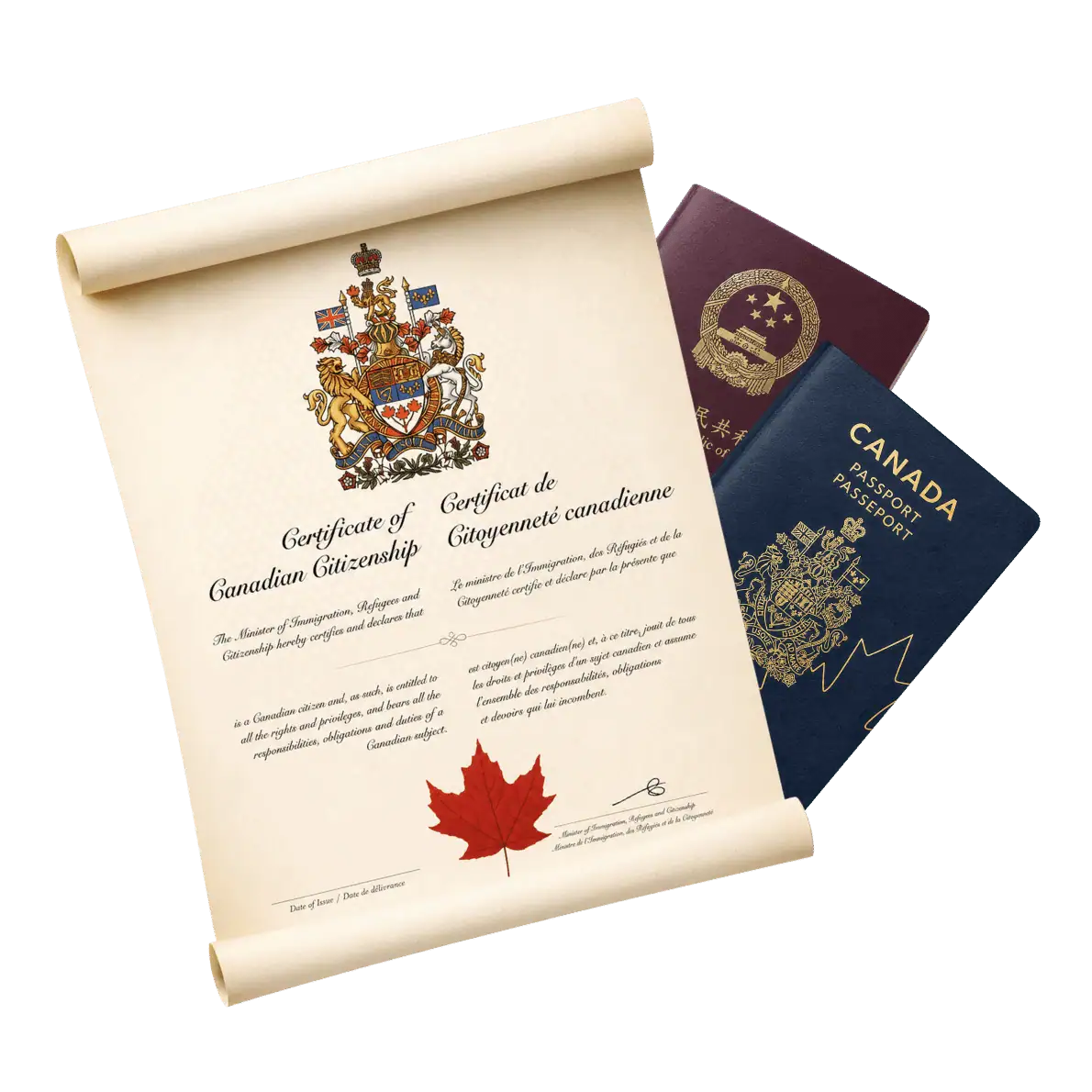
For China-born applicants, Canadian citizenship by descent may come from a parent who was Canadian while living in China for work, study, business, marriage, research, or family reasons. These cases often involve families whose Canada–China connection was already established before the child was born.
Canada and China have long-standing people-to-people, education, business, and family connections. Statistics Canada reported that China was one of the top five countries of birth for Canadian citizens by descent living in Canada in 2021. For some China-born children and adults, a Canadian parent or family background may already create a legal connection to Canada.
In these cases, the person is usually not applying to become Canadian. They are applying for a Canadian citizenship certificate to prove citizenship they may already have. This certificate can be important for a Canadian passport, future relocation to Canada, children’s citizenship questions, or family situations where Bill C-3 has made an older Canadian connection worth reviewing again.
China to Canada Express Entry
China remains an important source country for permanent residence through Canada’s Express Entry system. From 2021 to the first quarter of 2026, IRCC data shows 30,920 admissions of permanent residents under Express Entry for China, reflecting steady use of this pathway by skilled workers pursuing long-term settlement in Canada.
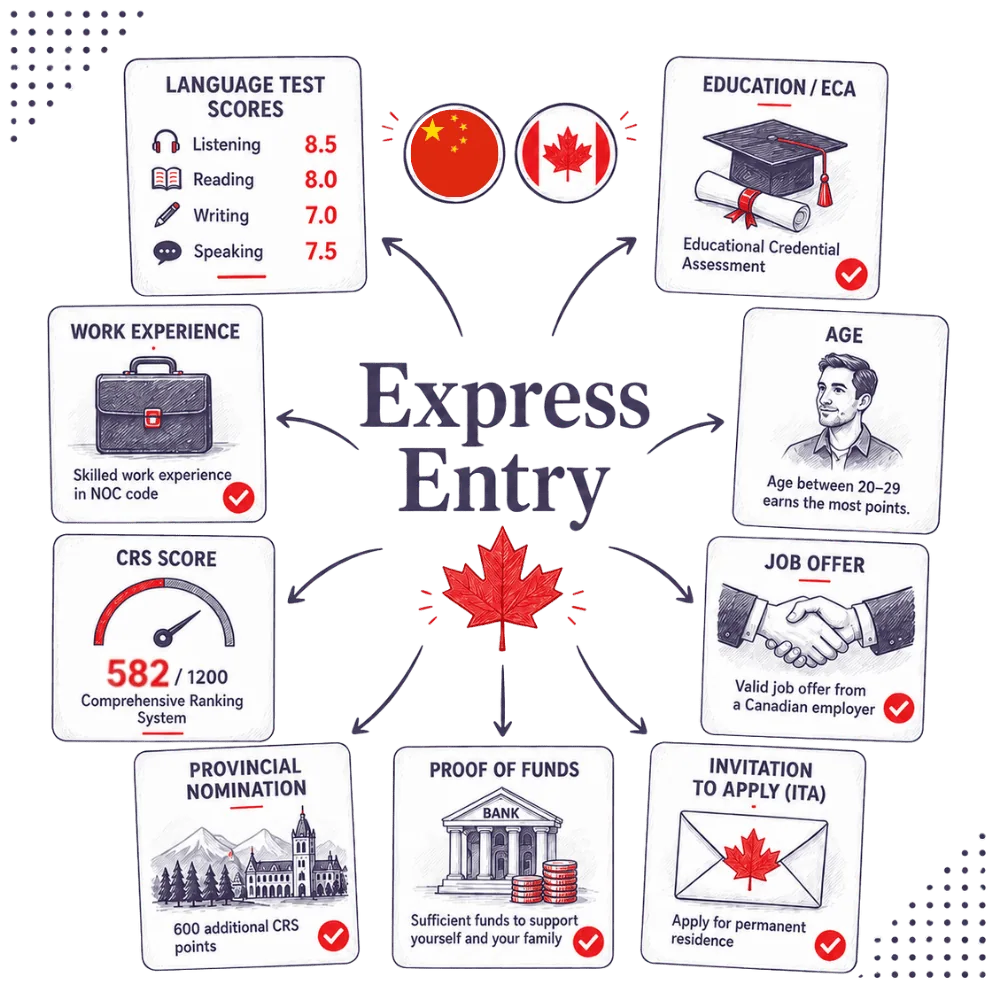
For applicants from China, a strong Express Entry profile starts with clear documentation of education, skilled work experience, and language ability. Foreign credentials usually need to be supported by an Educational Credential Assessment, while approved English or French test results help determine CRS competitiveness. Employment records, proof of funds where required, and consistent personal history are also important for avoiding issues after an invitation to apply.
A China-focused Express Entry plan should review the applicant’s CRS position, occupation, education background, work history, language potential, and possible provincial nomination options. Careful planning can help applicants identify weaker areas early and prepare a more complete permanent residence application.
China to Canada PNP
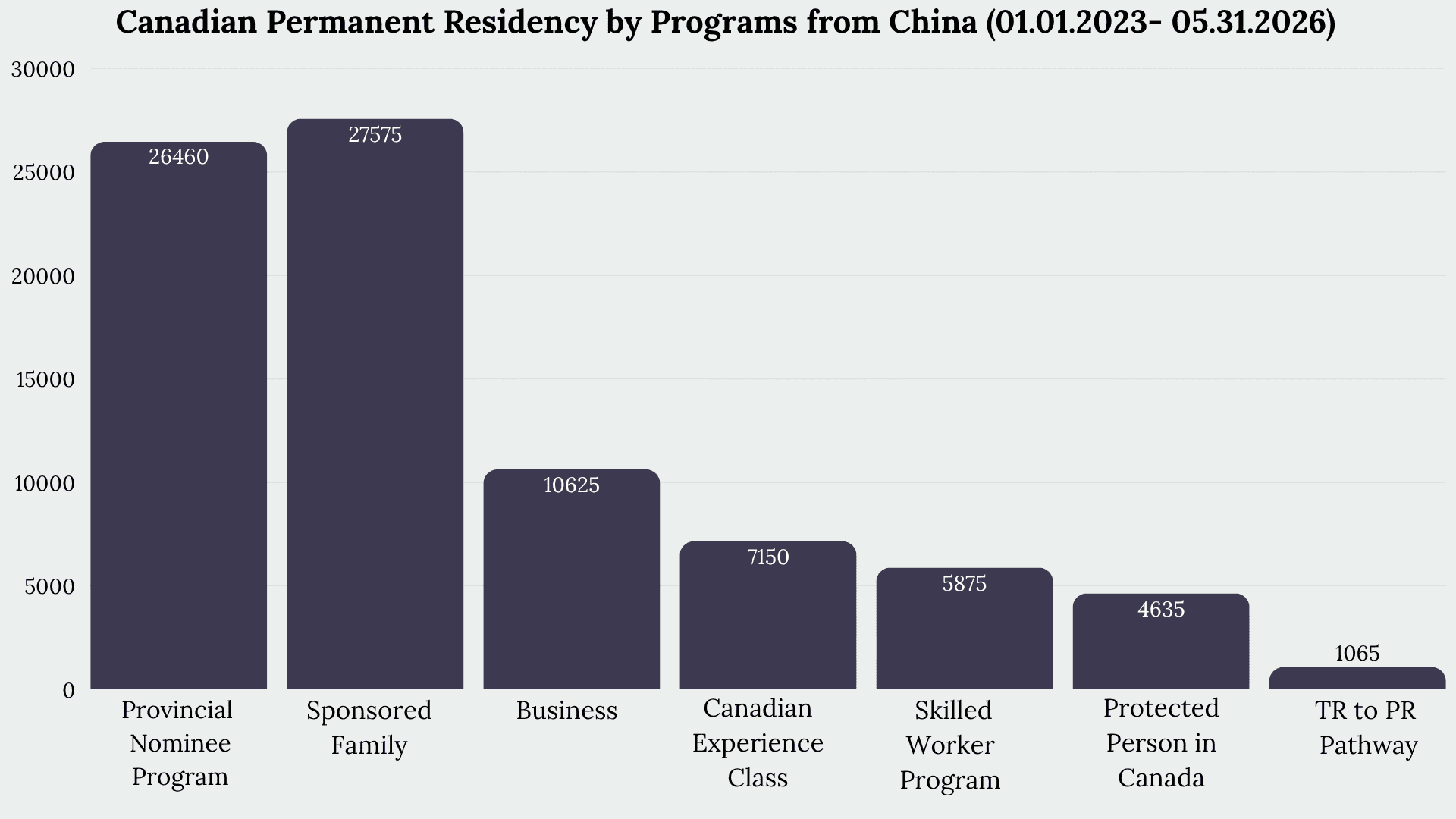
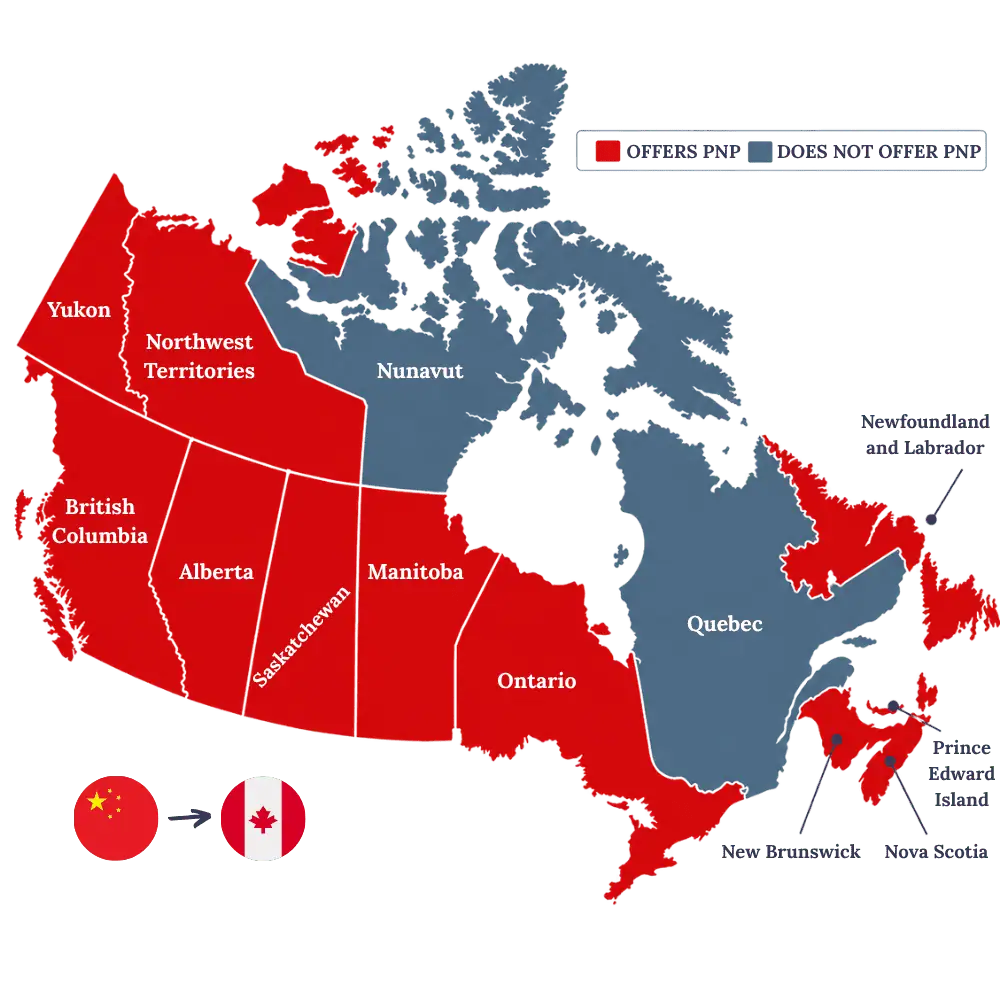
China is a strong source country for permanent residence through Canada’s Provincial Nominee Program. PNP pathways allow Canadian provinces and territories to nominate skilled workers whose education, occupation, work experience, language ability, and settlement plans align with local labour market needs.
For applicants in China, success through a PNP depends on identifying the right provincial pathway and preparing documents that support the stream’s requirements. Depending on the province, candidates may need skilled work experience, language test results, education credentials, an eligible occupation, a job offer, previous study or work experience in the province, or another connection that supports their intent to settle there.
A China-focused PNP strategy should compare provincial options based on the applicant’s occupation, education, work history, language scores, job offer potential, and long-term settlement goals. With the right preparation, applicants from China can identify suitable nomination opportunities and approach the provincial nomination process with greater clarity and confidence.
China to Canada Study Permit
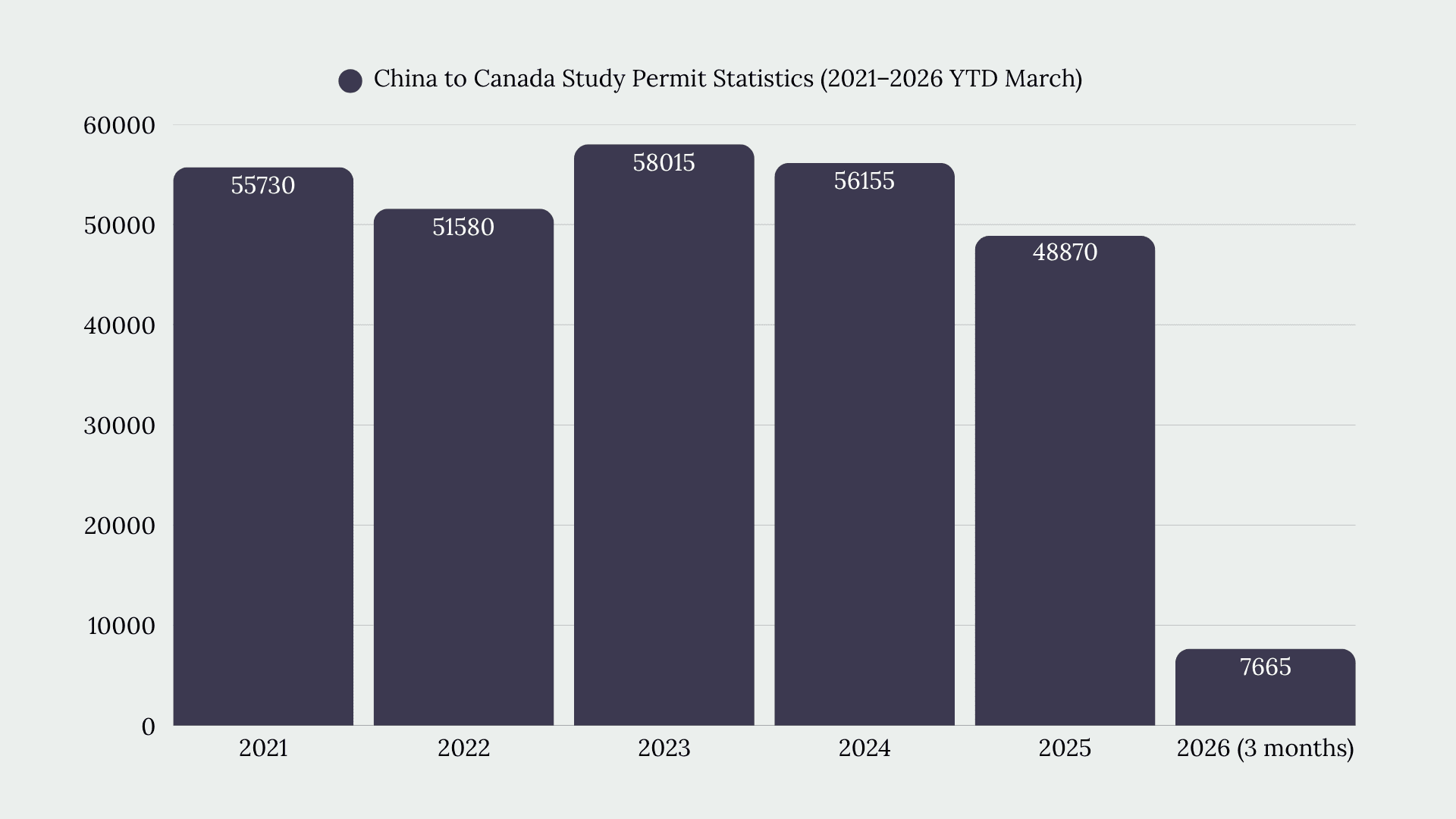
Applicants applying for a Canada study permit from the People’s Republic of China must follow the Beijing, Guangzhou and Shanghai visa office instructions for local document requirements. These instructions are listed in IMM 5977 — Beijing, Guangzhou and Shanghai Visa Office Additional Document Checklist: Study Permit, which is used together with the standard Canada study permit checklist.
For applicants from China, the local checklist also requires IMM 0104 — Details of Education, Employment and Travel. This form must be completed for the applicant and the applicant’s parents in English or French and Chinese.
Required Forms
Applicants from the People’s Republic of China must follow the Beijing, Guangzhou and Shanghai Visa Office Additional Document Checklist for study permits.
Country-specific visa office checklists:
- IMM 5977 — Beijing, Guangzhou and Shanghai Visa Office Additional Document Checklist: Study Permit
- IMM 0104 — Details of Education, Employment and Travel
IMM 5977 is used alongside the standard study permit checklist. It does not replace the general study permit requirements.
Applicants should also include:
- a copy of the national identity document, showing both sides;
- the original household registration document, also known as the hukou.
Documents in Chinese must be accompanied by an English or French translation.
Study Plan and Academic Records
IMM 5977 asks applicants from the People’s Republic of China to provide a study plan of no more than one page.
The study plan should explain how the proposed Canadian program relates to the applicant’s:
- academic background;
- technical or vocational background, where applicable;
- future career goals.
Applicants should also provide evidence of current or previous study, including:
- the most recent secondary or post-secondary degree, diploma, or certificate;
- the most recent transcripts.
These documents help show the applicant’s education history and support the purpose of study explained in the study plan.
Financial Evidence
IMM 5977 asks applicants from the People’s Republic of China to show that they have enough funds available to cover their stay in Canada.
Applicants should provide evidence of accumulated funds showing at least 12 months of financial history. Supporting documents may include:
- certificates of deposit dated within the last two months;
- deposit slips or bank passbooks;
- house or vehicle certificates;
- a written explanation of the source of funds.
Applicants should not submit life insurance booklets or other contracts as proof of funds.
Applicants should also provide evidence of their parents’ income or employment. This includes original employment letters from the parents’ current employers. If either parent owns all or part of a business, the application should include a notarized copy of the business registration.
If the applicant has a scholarship or other funding, the file should include an original letter explaining the funding the applicant will receive during each year of the proposed study program.
Police Certificates
Applicants who are 18 years of age or older should provide police certificates based on their residence history.
A police certificate should be provided from each country or territory where the applicant has lived for six consecutive months or longer since turning 18. Because the required certificates depend on the applicant’s age and past places of residence, applicants should review their full residence history and obtain the appropriate police certificates from each relevant country or territory.

China to Canada Super Visa
Applicants applying for a Canada Super Visa from China must follow the Beijing visa office instructions in addition to the standard Super Visa checklist. These instructions are listed in the Beijing Visa Office Instructions — IMM 5884.
For China applicants, IMM 5884 includes Super Visa-specific instructions on the Education, Employment and Travel form, private medical insurance, proof of an upfront medical examination, panel physician documents, inviter documents and household size, proof of the inviter’s status, and Canadian-source proof of financial support.
Applicant Forms
Applicants from China are assigned to the China Visa Office Instructions:
IMM 5884 requires a completed Education, Employment and Travel form for:
- The applicant.
- Each accompanying family member aged 18 years old and above.
The form must be completed in English or French and Chinese.
Medical Insurance & Exam
IMM 5884 requires satisfactory evidence of private medical insurance from a Canadian insurance company.
The insurance must:
- Be valid for a minimum period of one year from the date of entry.
- Cover health care, hospitalization, and repatriation.
- Provide minimum coverage of $100,000.
- Be valid for each entry to Canada.
- Be available for review by the examining officer upon request.
IMM 5884 also requires proof that the applicant has undergone a medical examination.
Applicants should complete the required medical examination before submitting the Super Visa application by visiting one of the Panel Physicians for China and Mongolia. The applicant must inform the Panel Physician that they intend to be a visitor to Canada.
When visiting the Panel Physician, the applicant must bring:
- 4 photos meeting the Photo Specifications.
- Original passport.
- Photocopy of the passport biodata page.
After the medical examination is completed, the Panel Physician will provide one copy of the medical examination form. This form must be submitted with the Super Visa application.
Submission of the medical examination form does not guarantee approval. Applicants should not make commitments until the Super Visa application has been approved. All medical exam costs are payable by the applicant and are non-refundable.
Inviter Documents
IMM 5884 requires the inviter in Canada to provide a written and signed invitation letter promising financial support for the duration of the applicant’s visit.
The inviter must also provide:
- A list showing the number of people in the inviter’s household.
- A copy of the inviter’s citizenship or immigration status document.
If the inviter provides a Permanent Resident Card, both sides must be copied.
Financial Support
IMM 5884 requires proof of the inviter’s ability to provide the promised financial support.
The proof must be independent, third-party documentation from a Canadian source that is reliable or easily verifiable.
Examples include, but are not limited to:
- Canada Revenue Agency Notice of Assessments.
- Employment letters showing salary.
- Pay stubs.
- Bank statements.
- Statements of Remuneration Paid.
- Financial statements prepared by a licensed professional.

China to Canada Visitor Visa
Applicants applying for a Canada visitor visa from China may need to follow the Beijing, Shanghai, Guangzhou or Hong Kong visa office instructions for local document requirements. These instructions are listed in the China Visa Office Instructions — IMM 5884, which is used together with the standard temporary resident visa checklist.
For China applicants, IMM 5884 includes the Education, Employment and Travel form, national identity and Hukou records, employer details in Chinese characters, Zhima Reports, China-based asset documents, Approved Destination Status group records, and official notes from the Chinese Ministry of Foreign Affairs.
Visa Office Instructions
China visitor visa applicants may need to follow the Beijing, Shanghai, Guangzhou or Hong Kong Visa Office Instructions in addition to the standard temporary resident visa requirements.
Relevant visa office instructions:
Where required for the applicant’s travel category, the Education, Employment and Travel form must be completed by the applicant and each accompanying family member aged 18 or older. The form must be completed in both English or French and Chinese.
Identity and Family Records
China visitor visa applicants must provide a copy of the photo side of their Chinese national identity document.
Where proof of the applicant’s relationship to a host or inviter in Canada is required, supporting documents may include a copy of the applicant’s Hukou or another relevant civil-status record.
China-Based Supporting and Purpose Documents
Where an employment letter is required, the employer’s name and address must be written in Chinese characters.
Depending on the applicant’s circumstances, supporting financial and asset records may include:
- a Zhima Report obtained through the Alipay mobile application, where available to Chinese nationals;
- an original house property certificate;
- vehicle registration documents; and
- relevant business registration, tax, sales, investment or company records.
Additional documents may also be required based on the purpose of travel.
Applicants visiting family members or friends should provide an invitation letter and evidence of their relationship to the host, such as a Hukou or other relevant civil-status record.
Business visitors and trade-show participants should provide letters explaining the purpose and duration of the trip, identifying the companies or organizations involved and confirming who will pay the travel expenses.
Independent tourists should provide a detailed itinerary and evidence of their planned accommodation.
Applicants travelling with an APEC Business Travel Card should include a copy of the card and documents supporting the purpose of the business visit.
Returning students or workers should provide evidence of their valid Canadian status and documents confirming their continuing studies or employment.
Applicants travelling for short-term study should provide an acceptance letter from the Canadian educational institution.
Transit applicants should provide their complete travel itinerary and, where applicable, proof that they are authorized to enter their destination country.
ADS Tourist Groups
Applicants travelling as part of an Approved Destination Status tourist group must provide a cover letter from the Chinese travel agent identifying:
- each traveller included in the group;
- the tour leader accompanying the group;
- the partner tour agency in Canada; and
- the group’s detailed travel itinerary.
A tour guide accompanying the group must also provide a copy of their tour leader licence and a letter from their employer confirming their job title and length of employment.
Official Passport Holders
Applicants travelling on official passports must provide an official note from the Chinese Ministry of Foreign Affairs supporting the intended visit to Canada.
Where the applicants are travelling as part of a delegation, one official note may be provided for the delegation.