How Long Does A Spousal Open Work Permit Take?
Last updated:
IRCC provides an estimate for how long a Spouse Open Work Permit (SOWP) application may take, but timelines can vary based on the type of application and IRCC’s workload. Wait times are commonly affected by where the application is submitted, the eligibility stream, how complete the file is, and whether biometrics, a medical exam, or additional documents are requested. Most applications move through stages such as submission, completeness review, officer assessment, and a final decision, with updates posted in the IRCC online account or portal (and sometimes in the status tracker). If a SOWP is submitted alongside the principal applicant’s spousal sponsorship PR application, the two files are processed separately and one may be finalized before the other.
IRCC Processing Time Estimates
Immigration, Refugees and Citizenship Canada (IRCC) publishes processing-time estimates on IRCC website. These estimates are not a guarantee, but they provide a general idea of how long it may take IRCC to process your application from submission to a final decision.
Processing times can vary depending on the SOWP eligibility stream/category, whether the applicant is applying from inside or outside Canada, and IRCC’s workload at the time you apply. Because estimates are updated regularly, always check IRCC’s processing-time tool for the most current information.
Several factors can influence how long a spouse or common-law partner open work permit application takes:
- Where the application is submitted (inside vs. outside Canada)
- The SOWP category or eligibility stream
- Application completeness and accuracy
- How quickly biometrics are completed (and a medical exam, if required)
- IRCC’s overall application volume and processing capacity
- Additional review steps (for example, background or security checks)
Applying with an In-Progress PR Application
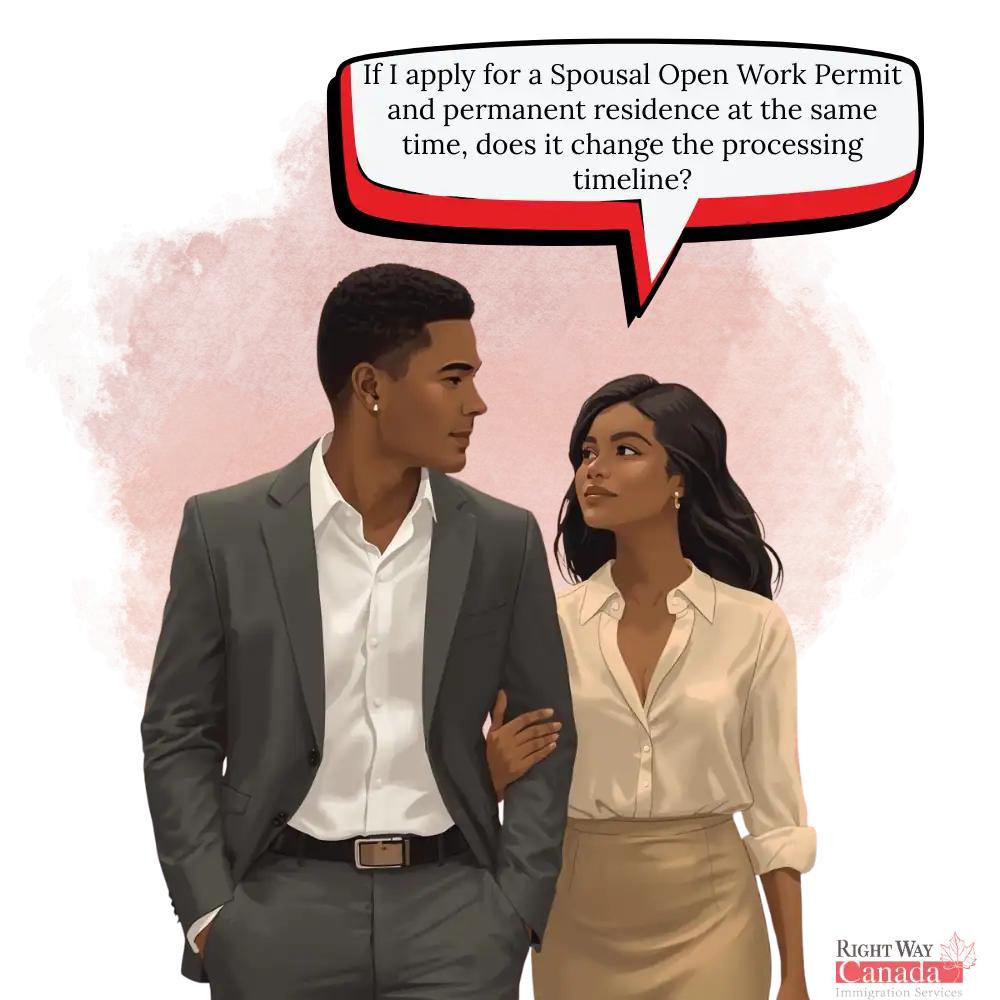
If a spousal open work permit and permanent residence (PR) application are submitted at the same time, it does not usually change the processing timeline or speed up PR. PR and the work permit are processed on separate tracks, and either one can be finalized first.
For in-Canada spousal sponsorship (SCLPC) cases, applicants usually apply for an open work permit only after IRCC has confirmed the PR application is complete (often around the time the Acknowledgement of Receipt (AOR) is issued after the completeness check).
Applying together can help avoid delays caused by waiting to submit the work permit later. The main benefit is usually work authorization while PR is processing, not faster PR application.
Tip (optional): If anything in the situation could be misunderstood (timing, status history, relationship timeline, proof of funds), a short Letter of Explanation can help connect the dots—without being overly detailed.
You can also learn more about Canadian Spousal Sponsorship.
Application Status Tracker
After an application is submitted, updates are typically available in the IRCC secure online account or the IRCC portal used to submit the application.
Updates may include:
- Requests for additional documents
- Biometrics instructions
- Medical exam requests (if applicable)
- The final decision
Spousal Open Work Permit applications may also show updates in the Application Status Tracker, but the IRCC secure online account or submission portal remains the primary source for messages, document requests, and decisions. However, if the application is to extend or change the conditions of a work permit, the tracker cannot be used; in that case, the applicant must check the online account instead, or link a paper application to an online account.
If the application was submitted through an authorized representative portal or filed through a different portal created by the applicant, the application may need to be linked to an IRCC secure online account to receive direct notifications and document requests. When linking, the information entered should match the application details exactly to avoid errors.
Delays most commonly occur due to missing documents, incomplete forms, unpaid or incorrect fees (including biometrics fees), documents not translated into English or French, or when IRCC requests additional information. To help avoid delays, it’s important to submit a complete SOWP document checklist.
If the application has gone beyond normal processing times, or if important information needs to be updated after submission, the applicant or representative can contact IRCC through the webform. It can also be used to submit new supporting documents or report changes such as updated contact details, marriage, or the birth of a child.
If the applicant is already in Canada and their current status will expire before a decision is made, they may also need to look at their work permit extension or status-extension options.
Application Timeline
After a Spousal Open Work Permit (SOWP) application is submitted, IRCC generally processes it through a series of stages. Not every application goes through every step, and the order can vary depending on the applicant’s circumstances and whether the application is submitted from inside or outside Canada.
Submission: The application is submitted online and the required fees are paid. The online account will show that the application was submitted. An application number or confirmation message may appear only after IRCC opens the file and confirms it is complete, so this may not happen immediately.
Completeness check: IRCC reviews the application to confirm that required forms and documents are included. If essential information or documents are missing, the application may be returned as incomplete without being processed.
Biometrics (if required): If biometrics are required, IRCC issues a biometric instruction letter after submission. IRCC generally will not finalize the application until biometrics are completed.
Medical exam (only if required): A medical exam is required only in certain cases, such as when the work involves health care, child care, or primary/secondary education, or when the applicant has lived in certain countries for 6 months or more. If a recent immigration medical exam is still valid, IRCC may reuse the results. If a new exam is required, IRCC will send instructions after submission, and processing may continue once the results are received.
Eligibility and Admissibility Assessment: An immigration officer assesses eligibility and admissibility. During this stage, IRCC may request additional documents or clarification.
Decision and issuance: If approved, a decision letter is posted in the online account.
- Outside Canada: approval usually means a letter of introduction; the actual permit is typically issued at entry if all conditions are met.
- Inside Canada: the work permit is usually mailed after approval, and the approval message may matter for when work can begin.
