Move From Vietnam to Canada With Licensed Immigration Consultants
Choosing to immigrate to Canada is an important and personal decision. RightWay Canada Immigration Services supports individuals and families in Vietnam who are pursuing permanent residence, study or work opportunities, family reunification or another Canadian immigration pathway. Our role is to make the process clearer, more manageable and carefully prepared from the beginning.
Our team of licensed Canadian immigration consultants is regulated by the College of Immigration and Citizenship Consultants (CICC) and works in accordance with Canadian immigration requirements. Since 2016, RightWay Canada has assisted 131 clients from Vietnam and earned multiple industry recognitions, along with a strong reputation reflected in positive client reviews.
Every immigration case is different. We take the time to understand each applicant’s circumstances and goals, assess the available options and provide clear guidance on eligibility, required documents and the steps ahead. Our support goes beyond completing forms, helping applicants approach the process with greater clarity and confidence. Book a consultation with a licensed immigration consultant to discuss your individual situation. Information about our services and pricing is available on our fees page.

Vietnam to Canada Spousal Sponsorship
Applicants from Vietnam do not have additional Vietnam-specific IRCC forms or special country-specific document requirements for spousal sponsorship. Applications should therefore follow the standard IRCC spousal sponsorship instructions and document checklist, with careful attention to complete identity and civil-status documents, required translations and clear evidence supporting the relationship.
Canada’s spousal sponsorship program allows eligible Canadian citizens and permanent residents to sponsor a spouse, common-law partner or conjugal partner for permanent residence. IRCC assesses the sponsor’s eligibility, the genuineness of the relationship and the sponsored applicant’s admissibility before making a final decision.
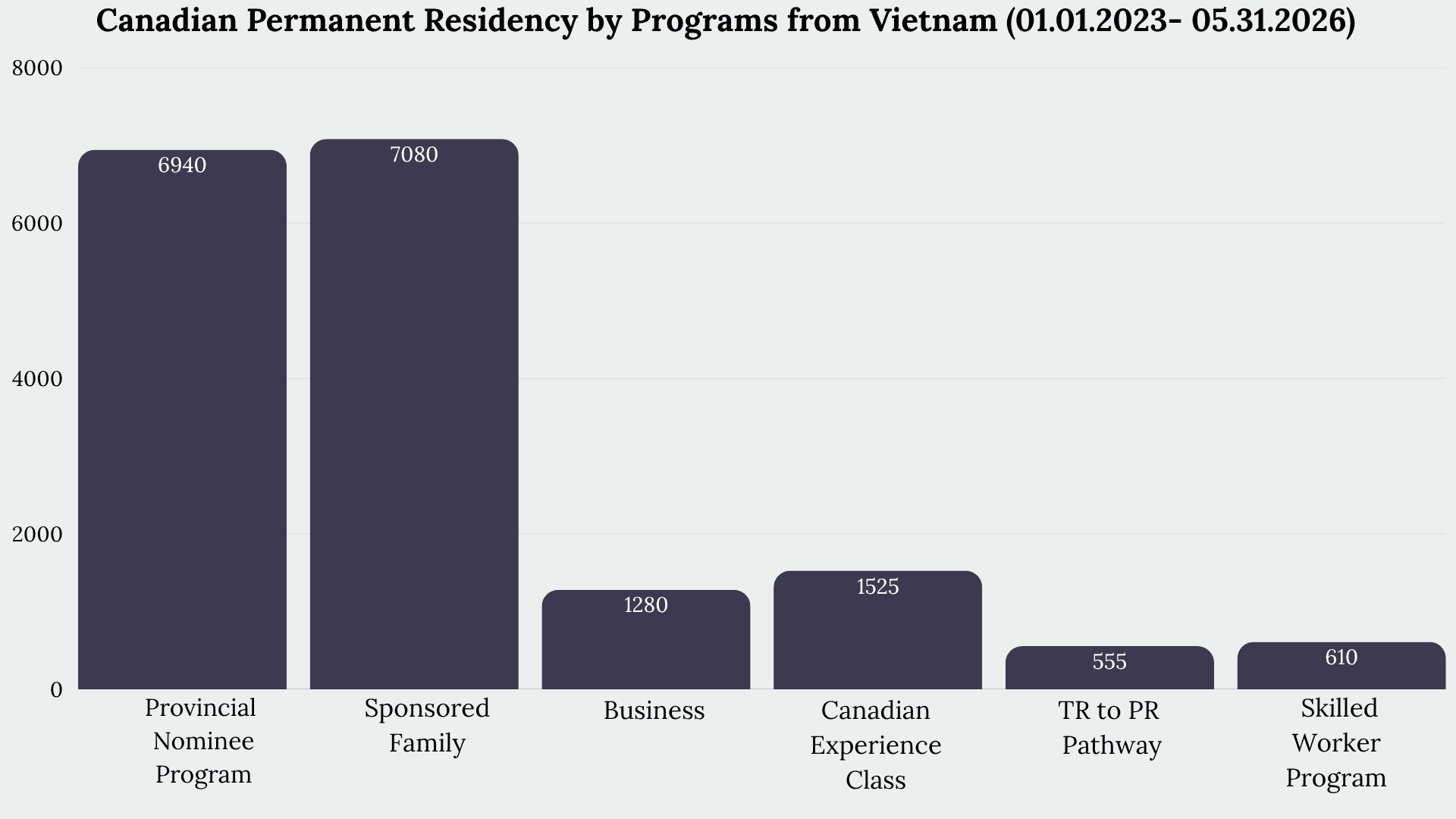
IRCC permanent residence statistics show that 5,825 Vietnamese citizens were admitted to Canada as sponsored spouses or partners from 2023 through May 2026. This included 1,830 admissions in 2023, 1,885 in 2024, 1,390 in 2025 and 720 from January to May 2026.

Vietnam to Canada Express Entry
Vietnam is a notable source country for permanent residence through Canada’s Express Entry system. From 2021 to the first quarter of 2026, IRCC data shows 5,040 admissions of permanent residents under Express Entry for Vietnam, reflecting steady interest among skilled workers moving from Vietnam to Canada.
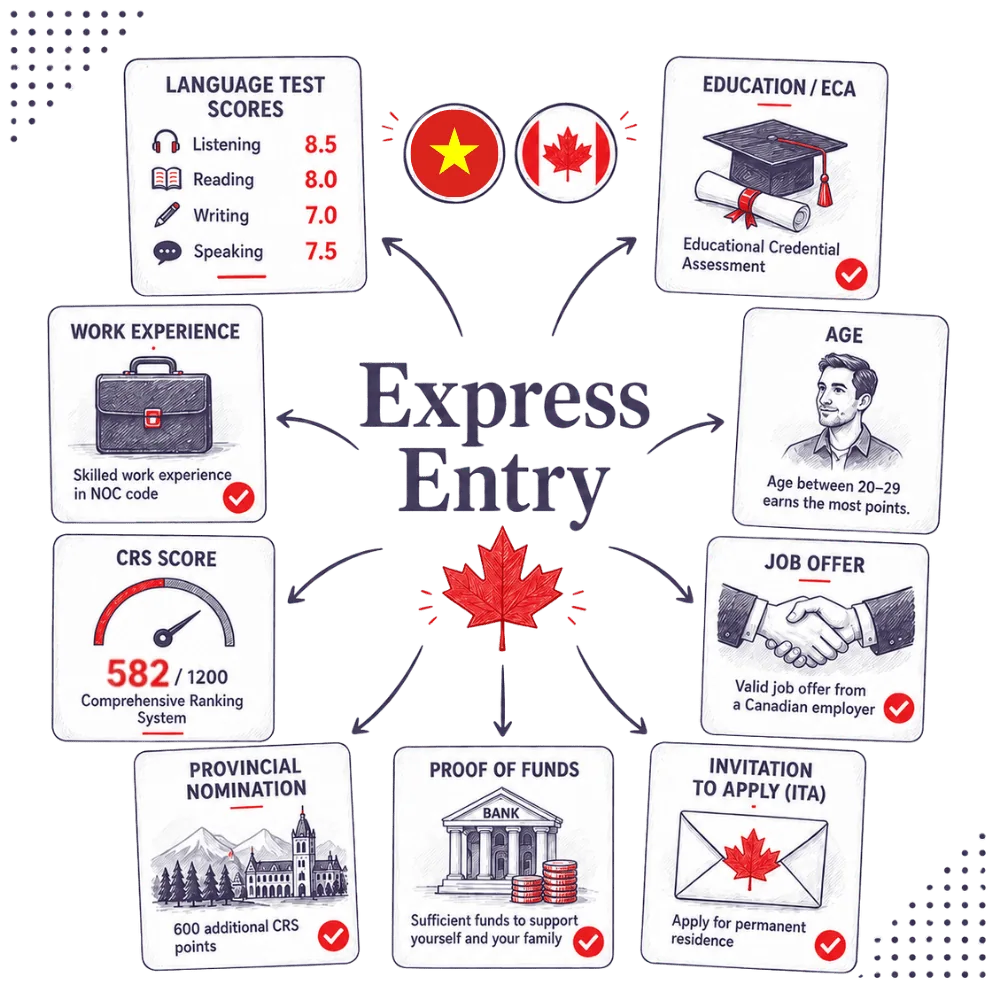
For applicants in Vietnam, Express Entry success depends on a complete and well-documented profile supported by competitive language test results, an Educational Credential Assessment for foreign education, accurate skilled work experience records, and proof of funds where required. Candidates with strong English or French results, Canadian study or work experience, or skilled occupations aligned with provincial nomination opportunities may be able to improve their CRS competitiveness.
A Vietnam-focused Express Entry strategy should connect the applicant’s education, occupation, work history, language scores, and possible provincial nomination pathways. With the right preparation, applicants from Vietnam can strengthen their profile, improve their competitiveness, and move through the permanent residence process with greater clarity and confidence.
Vietnam to Canada PNP
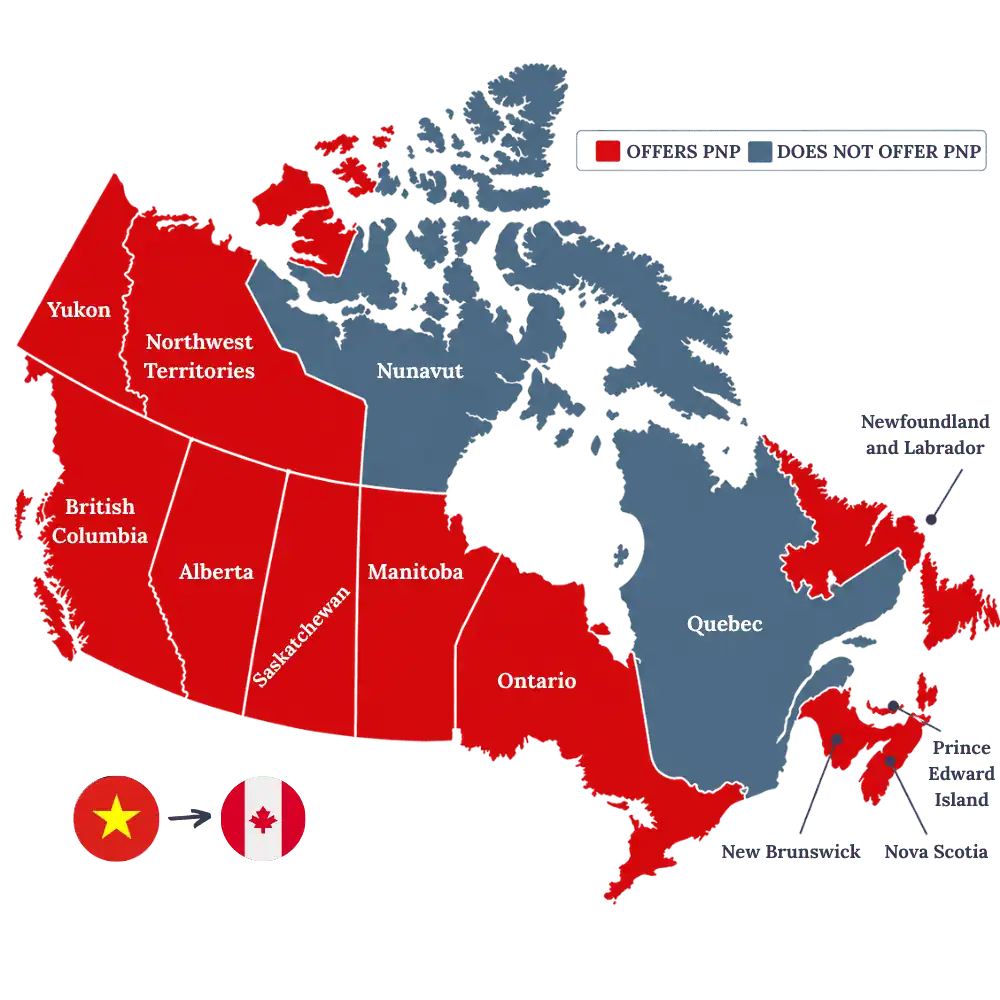
Vietnam is a growing source country for skilled immigration to Canada, and the Provincial Nominee Program can be a useful pathway for applicants whose occupation, education, or work experience aligns with a province’s selection priorities. For many candidates, the PNP offers a more targeted route than relying only on federal selection.
For applicants from Vietnam, province selection should be based on how the profile fits a specific stream’s requirements. Occupation, work history, education, language results, job offer, Canadian study or work experience, and settlement connections can all influence which options are realistic. Clear documents for employment history, credentials, funds, and settlement intent can also strengthen the application.
PNP applications may be connected to Express Entry or handled through a separate non-Express Entry process. IRCC confirms that an Express Entry provincial nomination adds 600 CRS points, which can significantly improve a candidate’s chance of receiving an invitation to apply. A Vietnam-focused PNP plan should compare suitable provinces early and prepare the application around the stream that best fits the applicant’s profile.
Vietnam to Canada Study Permit
Applicants applying for a Canada study permit from Vietnam must follow the Ho Chi Minh City visa office instructions for local document requirements. These instructions are listed in the Ho Chi Minh City Visa Office Additional Document Checklist — IMM 5572, which is used together with the standard Canada study permit checklist.
For Vietnam applicants, IMM 5572 focuses on application timing, the study plan, current or previous study records, police certificates where required, and financial documents showing how the studies will be funded.
Required Forms
Vietnam study permit applicants must follow the Ho Chi Minh City Visa Office Additional Document Checklist for study permits.
Country-specific checklist:
IMM 5572 is used alongside the standard study permit checklist. It does not replace the general study permit requirements.
Applicants are also encouraged to submit their application at least three months before their proposed travel date.
Study Plan and Records
Vietnam study permit applicants should provide a study plan explaining the purpose of their proposed studies in Canada.
The study plan should explain:
- why the applicant wants to study in Canada at the educational institution and in the program to which they have been accepted;
- the applicant’s overall educational goals;
- how the Canadian diploma or degree may improve their future employment opportunities; and
- how the applicant and their parents plan to fund the proposed studies.
Applicants should also provide evidence of their current or previous education, including:
- a photocopy of their most recent diploma;
- school transcripts; and
- high school graduation examination results, where applicable.
Financial Evidence
Vietnam study permit applicants should provide evidence that they meet IRCC’s current financial requirements for their proposed studies in Canada.
Financial documents may include:
- proof that first-year tuition fees have already been paid;
- certificates of deposit issued within the previous two months showing the funds currently available;
- bank books; and
- evidence of the applicant’s parents’ income and employment, such as employment letters, business registration documents or tax receipts.
When someone other than the applicant’s parents is providing financial support, or when the applicant is employed and funding their own studies, the same types of supporting financial documents should be provided.
Applicants receiving funding from a Canadian educational institution or another organization should also include a letter explaining the amount and type of funding they will receive during each year of the proposed study program.
Police Certificates
Vietnam study permit applicants who are over 18 years of age should provide police certificates based on their residence history.
A police certificate should be provided from each country where the applicant has lived for more than six months since turning 18.

Vietnam to Canada Visitor Visa
Applicants applying for a Canada visitor visa from Vietnam may need to follow IRCC’s visa office-specific instructions. These instructions are listed in the Vietnam Visa Office Instructions — IMM 5972, which is used together with the standard temporary resident visa checklist.
For Vietnam applicants, IMM 5972 does not identify any separate Vietnam-specific documents, local authority records, country-specific forms, or Vietnam-only submission requirements.
Visa Office Instructions
Vietnam visitor visa applicants may need to follow the Vietnam Visa Office Specific Instructions in addition to the standard temporary resident visa requirements.
Relevant visa office instructions:
IMM 5972 includes additional instructions concerning financial support, CAN+ applicants, short-term and returning students, returning workers and transit applications.
Financial Support and CAN+
Applicants should provide financial documents showing that they can pay for their visit to Canada.
Financial evidence may include:
- bank statements covering the previous three months;
- recent pay slips or proof of other income; and
- documents showing savings, investments, property or other assets.
If another person is paying for the visit, the application should include:
- a signed letter confirming the financial support;
- evidence that the person has sufficient funds;
- an explanation of the relationship between the applicant and the person providing support; and
- details of the expenses that will be covered.
The financial support documents should be dated within three months of the application.
Applicants who qualify under CAN+ may not need to provide financial evidence when they submit proof of qualifying previous travel to Canada or a valid United States non-immigrant visa.
Short-Term Students and Returning Applicants
Applicants planning to study in Canada for six months or less should provide a letter of acceptance from the Canadian educational institution. The letter should state:
- the name of the course or program;
- the tuition fees;
- the start and end dates; and
- the deadline for registration.
Applicants returning to Canada to continue their studies should provide:
- a copy of their valid Canadian study permit; and
- a recent letter from their educational institution confirming current enrolment and the date they are expected to resume their studies.
Applicants returning to Canada to continue working should provide:
- a copy of their valid Canadian work permit; and
- a recent letter from their Canadian employer confirming that they are expected to return and resume their employment.
Transit Applications
Applicants travelling through Canada on their way to another country should provide:
- a complete travel itinerary showing their entry to and departure from Canada;
- proof of onward travel; and
- a valid visa or other evidence that they are authorized to enter their destination country, where required.