Move From Iran to Canada With Licensed Immigration Consultants
Last updated:
Choosing to immigrate to Canada is an important and personal decision. RightWay Canada Immigration Services supports individuals and families in Iran who are pursuing permanent residence, study or work opportunities, family reunification or another Canadian immigration pathway. Our role is to make the process clearer, more manageable and carefully prepared from the beginning.
Our team of licensed Canadian immigration consultants is regulated by the College of Immigration and Citizenship Consultants (CICC) and works in accordance with Canadian immigration requirements. Since 2016, RightWay Canada has assisted a number of clients from Iran and earned multiple industry recognitions, along with a strong reputation reflected in positive client reviews.
Every immigration case is different. We take the time to understand each applicant’s circumstances and goals, assess the available options and provide clear guidance on eligibility, required documents and the steps ahead. Our support goes beyond completing forms, helping applicants approach the process with greater clarity and confidence. Book a consultation with a licensed immigration consultant to discuss your individual situation. Information about our services and pricing is available on our fees page.
Iran to Canada Spousal Sponsorship
Applicants applying for spousal sponsorship from Iran must follow the country-specific IRCC instructions alongside the standard sponsorship application checklist. These instructions identify the additional local forms, identity documents, and supporting evidence that may be required for an application involving Iranian nationals.
For Iran applicants, the country-specific requirements include additional IMM forms, copies of passport pages, Shenas Nameh identity documents, affidavits for unregistered civil events, and military service or military exemption card documents.
Country-Specific Documents
Applicants from Iran must complete the following country-specific forms where applicable:
- Supplementary Information – Your Travels [IMM 5562]
- Required for the principal applicant.
- Required for all family members included in the application who are 18 years old or older.
- Details of Military Service [IMM 5546]
- Required for anyone included in the application who has ever:
- held a high-ranking or senior official government position, or
- served in the military, army, defence, or police unit, including National Service.
- Required for anyone included in the application who has ever:
If IMM 5546 applies, submit a copy of all pages of the person’s military card or booklet, including blank pages.
Identity Documents
If the applicant holds an Iranian passport, the applicant and all family members included in the application must provide copies of:
- the first 10 pages of each passport, including the page showing the valid dates
- the identity cards known as Shenas Nameh, issued by the General Department of Civil Status and Census Registration, Ministry of the Interior
If possible, passports should be valid for at least 3 years after the date of application.
Civil Documents
If a birth, marriage, or divorce happened outside Iran and is not registered in the Shenas Nameh, provide:
- a copy of the certificate issued abroad
- a sworn affidavit explaining why the event is not registered in the Shenas Nameh
Military Documents
The principal applicant must submit a copy of their military service card or military exemption card.
Iran to Canada Express Entry
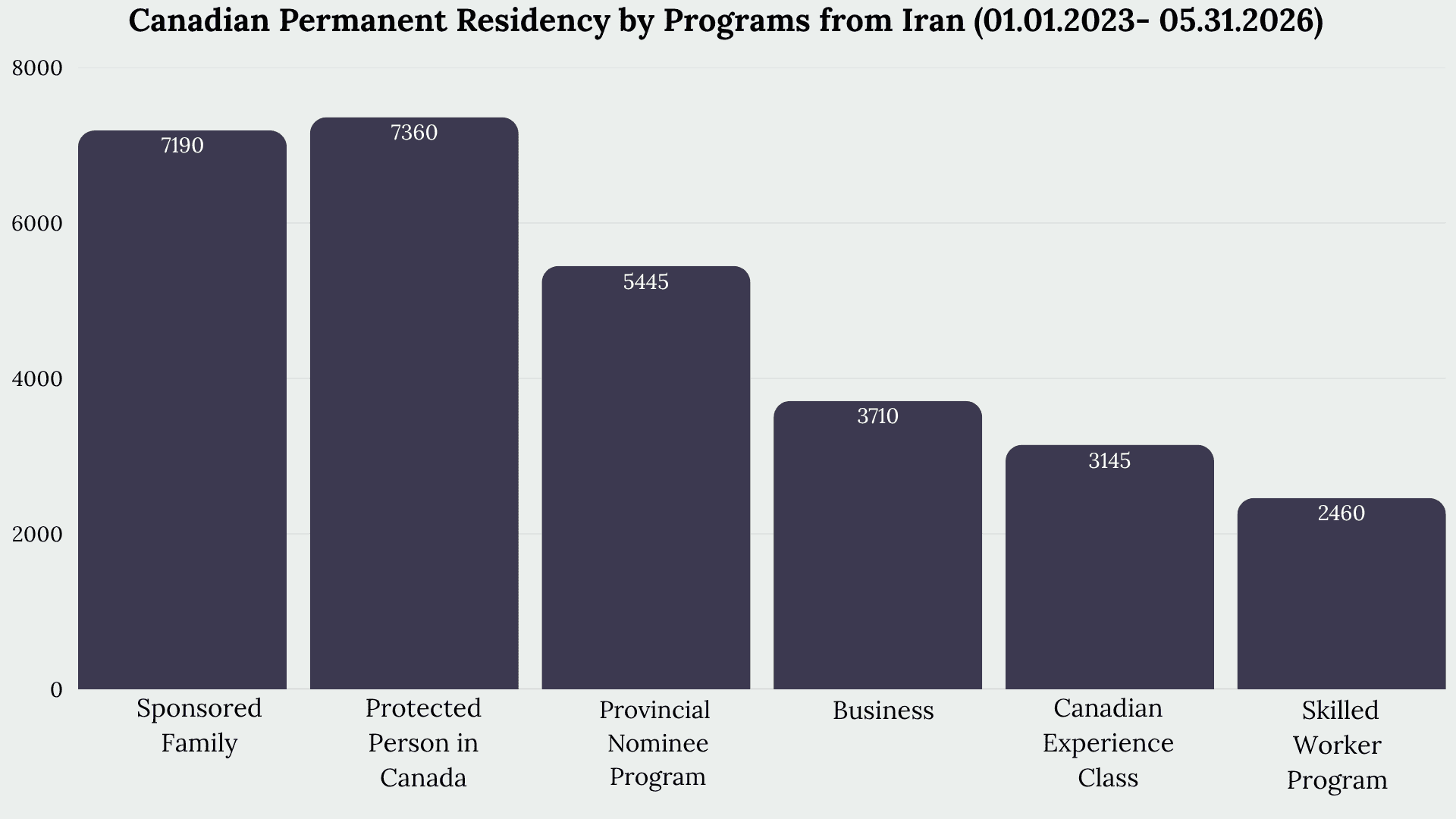
Iran is an important source country for permanent residence through Canada’s Express Entry system. From 2021 to the first quarter of 2026, IRCC data shows 11,735 admissions of permanent residents under Express Entry for Iran, reflecting the continued role this pathway plays for Iranian professionals and skilled workers moving to Canada.
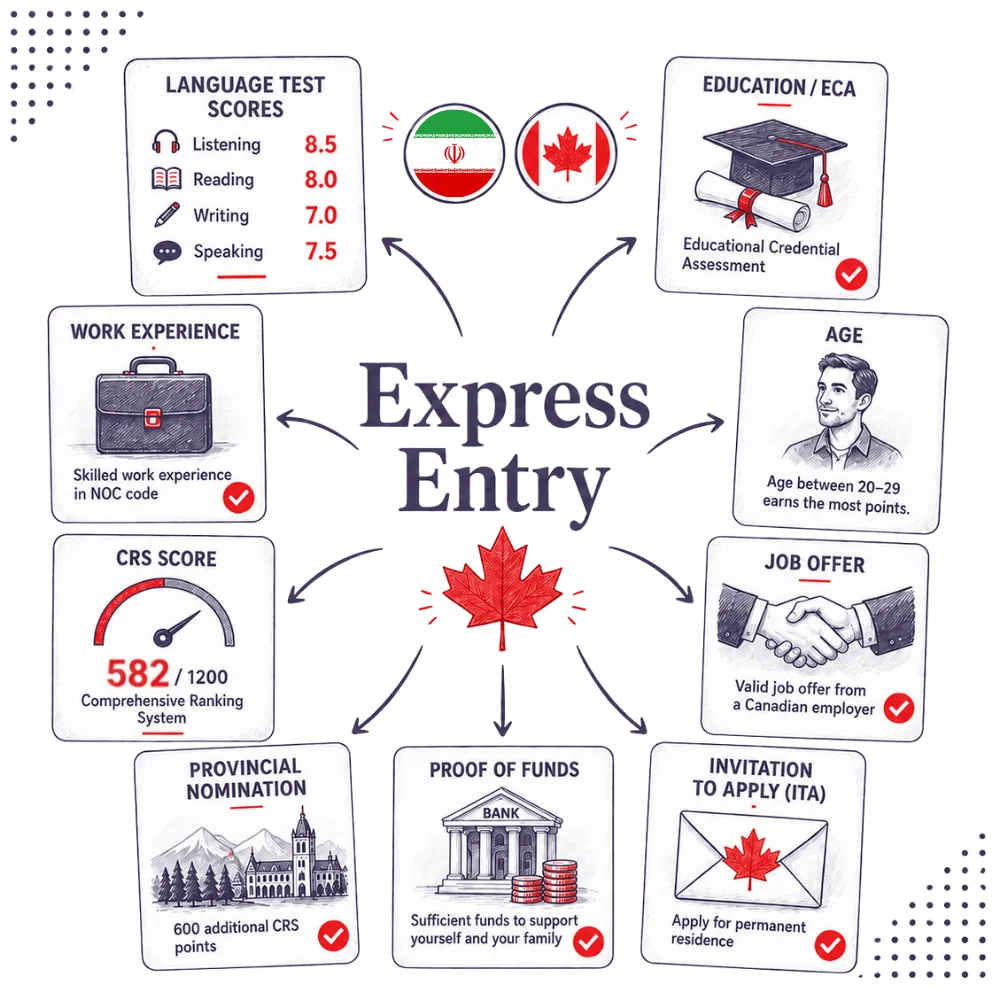
For applicants from Iran, a strong Express Entry profile often depends on how well education, professional experience, language results, and personal history are documented. An Educational Credential Assessment, approved English or French language test results, consistent employment records, and proof of funds where required can help support both CRS competitiveness and application credibility.
An Iran-focused Express Entry plan should review the applicant’s CRS score, occupation, education background, work history, language potential, and possible provincial nomination options together. Careful preparation can help applicants identify weaker areas, strengthen the profile before an invitation, and prepare a more complete permanent residence application.
Iran to Canada PNP
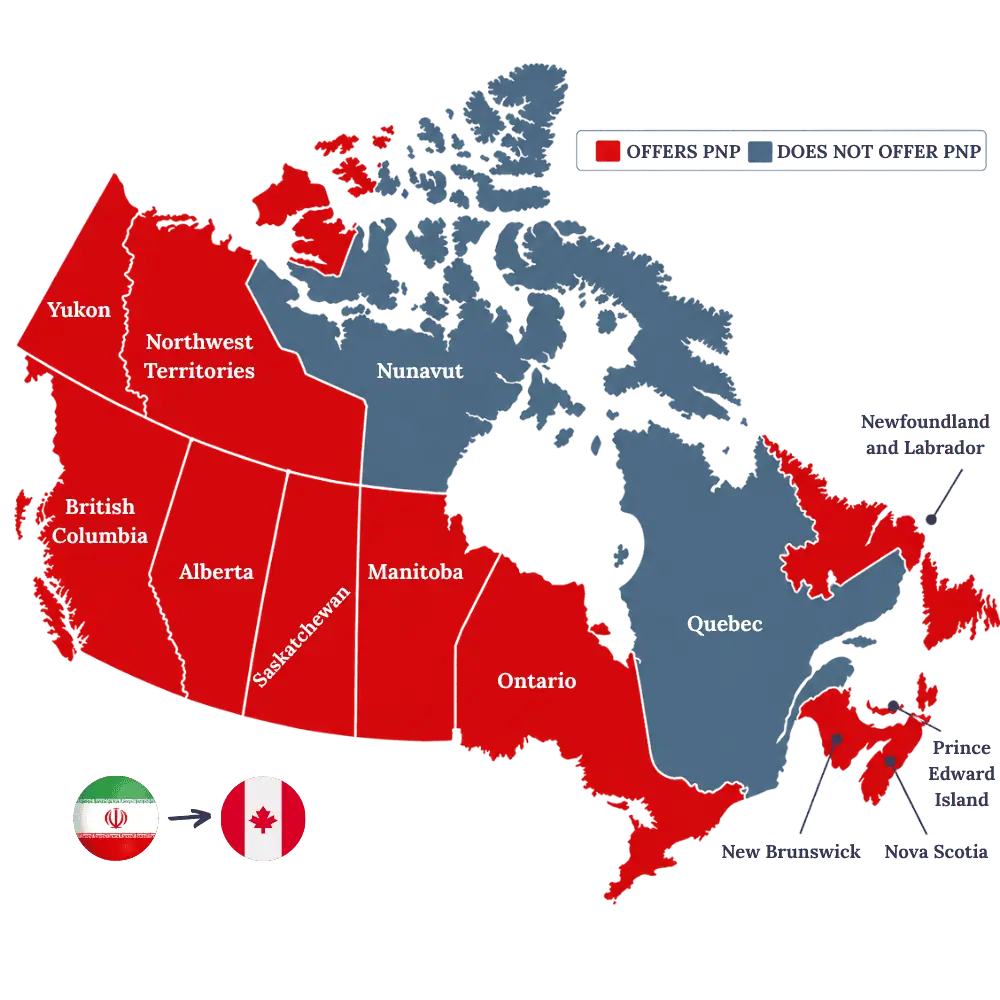
For many skilled applicants from Iran, the Provincial Nominee Program can create a more targeted route to Canadian permanent residence. Instead of relying only on federal selection, the PNP allows a province or territory to nominate candidates whose skills, education, work experience, and settlement plans fit its local economic needs.
An Iran-focused PNP strategy should start with the applicant’s professional profile. Occupation, education, work history, language results, job offer, Canadian study or work experience, and ties to a province can all influence which streams may be suitable. Because provincial programs can have specific document and eligibility rules, applicants should prepare clear records of their credentials, employment history, and settlement intent before applying.
PNP options may be connected to Express Entry or may follow a non-Express Entry process. For Express Entry candidates, IRCC confirms that a provincial nomination adds 600 CRS points, which can strongly improve the chance of receiving an invitation to apply. For applicants from Iran, comparing both PNP pathways can help identify the most suitable province, stream, and permanent residence plan.
Iran to Canada Study Permit
Applicants applying for a Canada study permit from Iran must follow the Ankara visa office instructions for local document requirements. These instructions are listed in the Ankara Visa Office Additional Document Checklist — IMM 5816, which is used together with the standard Canada study permit checklist.
For Iranian applicants, IMM 5816 includes both general Ankara checklist documents and Iran-specific requirements. These include post-secondary records, recent language test results, a one-page personal statement, work-history documents, and additional documents for applicants residing in Iran, Iranian men over 18, and Master’s or PhD applicants.
Required Forms
Iranian study permit applicants must follow the Ankara Visa Office Additional Document Checklist for study permits.
Country-specific checklist:
IMM 5816 is used alongside the standard study permit checklist. It does not replace the general study permit requirements.
Student Records
Applicants from Iran should provide documents confirming their post-secondary education history, including transcripts and proof of graduation from every post-secondary institution they have attended.
Applicants should also provide results from an international English or French language test taken within the previous two years. Examples listed in the checklist include:
- IELTS;
- TOEFL;
- DELF; and
- TEF.
These documents help demonstrate the applicant’s academic background and language preparation for studies in Canada.
Personal Statement
Iranian applicants must include a one-page personal statement explaining how the proposed Canadian study program relates to their academic background and future career plans.
The statement should clearly connect:
- the applicant’s previous studies;
- the Canadian program they intend to pursue; and
- their career goals after completing the program.
The personal statement should be specific to the applicant’s circumstances and explain why the proposed study plan is a logical academic and professional progression. It should not rely on a general explanation of why Canada is an attractive study destination.
Work Documents
Applicants from Iran who have worked during the previous three years should provide documents confirming their employment or self-employment history.
Employed applicants should include detailed employment letters showing:
- the period of employment;
- the position held;
- the salary; and
- the applicant’s job responsibilities.
Self-employed applicants should provide supporting business records, which may include:
- income statements;
- proof of business ownership or operation;
- a trade licence;
- a description of the business activities;
- contracts; or
- similar business documents.
These records help confirm the applicant’s personal history and explain how their recent work experience relates to the proposed study plan.
Iran-Specific Documents
Iranian applicants and applicants residing in Iran may need to provide additional identity, military-status and research-study documents.
Applicants residing in Iran must include a copy of their Shenasname with an official translation.
Iranian male applicants over the age of 18 must provide documents confirming their military status. Depending on their circumstances, these may include:
- a military service completion card;
- the military service table showing IRGC or Artesh in the organization column;
- proof of military exemption or deferral;
- an explanation of the grounds for the exemption; and
- a copy of the legal reference or decree under which the exemption was granted.
Iranian students, as well as students residing in Iran, who plan to pursue a master’s or PhD program in Canada must also provide detailed information about their proposed research studies, including:
- a detailed CV covering their education, employment and volunteer activities;
- the intended field of study in Canada;
- the title and description of the proposed thesis;
- the name and contact information of the intended supervisor in Canada;
- the name and contact information of their previous supervisor in Iran;
- a list of publications and research papers; and
- detailed information about the source of funding for their studies in Canada.

Iran to Canada Visitor Visa
Applicants applying for a Canada visitor visa from Iran may need to follow the Ankara visa office instructions in addition to the standard temporary resident visa checklist. These instructions are listed in the Ankara Visa Office Instructions — IMM 5855.
For Iran applicants, IMM 5855 includes Shenasname records for applicants residing in Iran, military service or exemption documents for Iranian males over 18, and additional study or research details for students attending a Master’s or PhD program in Canada.
Visa Office Instructions
Iran visitor visa applicants may need to follow the Ankara Visa Office Instructions in addition to the standard temporary resident visa requirements.
Relevant visa office instructions:
IMM 5855 includes additional instructions concerning Iranian civil and military documents, Master’s and PhD applicants, financial and occupational evidence, returning students and workers, business travel and visits to hosts in Canada.
Iranian Civil and Military Documents
Applicants residing in Iran must provide a copy of their Shenasname together with an official translation.
Iranian male applicants over 18 must also provide either:
- their military service completion card and completed military service table, with IRGC or Artesh identified in the organization column; or
- proof that their military service has been deferred or that they are exempt.
Applicants claiming an exemption must explain the grounds for the exemption and provide a copy of the legal reference or decree under which it was granted.
Master’s and PhD Applicants
Iranian students and students residing in Iran who plan to attend a Master’s or PhD program in Canada must provide:
- a detailed curriculum vitae listing all studies, employment and volunteer activities;
- the intended field of study in Canada;
- the title and description of the thesis or research to be completed in Canada;
- the name and contact information of the intended supervisor in Canada;
- the name and contact information of the supervisor in Iran for previous studies;
- a list of publications and research papers; and
- details of the source of funding for their studies in Canada.
Financial and Occupational Evidence
Applicants should provide documents showing their financial circumstances and current occupation.
Financial evidence should include bank statements covering the previous six months. Applicants may also provide documents showing other assets or sources of income.
If another person, organization or host in Canada is paying for the visit, the application should include:
- a signed letter confirming the financial support;
- evidence that the person or organization has sufficient funds;
- an explanation of the relationship between the applicant and the person providing support; and
- details of the expenses that will be covered.
Applicants should also provide evidence of their current activity, as applicable:
- employees should provide a letter confirming their position, salary, length of employment and approved leave;
- self-employed applicants should provide business registration, tax and financial records;
- retired applicants should provide pension evidence; and
- students should provide proof of current enrolment.
Returning Applicants, Business and Hosted Visits
Applicants returning to Canada to continue their studies should provide:
- a copy of their valid study permit or approval document;
- a current letter from the Canadian educational institution confirming enrolment; and
- recent transcripts or other evidence of academic progress, where applicable.
Applicants returning to Canada to continue working should provide:
- a copy of their valid work permit or approval document; and
- a recent letter from the Canadian employer confirming continued employment, position and expected return date.
Business visitors should provide letters from their employer and the Canadian business or organization they plan to visit. The letters should explain the purpose and duration of the trip, identify the organizations involved and confirm who will pay the travel expenses.
Applicants visiting family members, friends or another host in Canada should provide:
- an invitation letter explaining the purpose and expected duration of the visit;
- proof of the host’s immigration status in Canada; and
- details of any accommodation or financial support the host will provide.