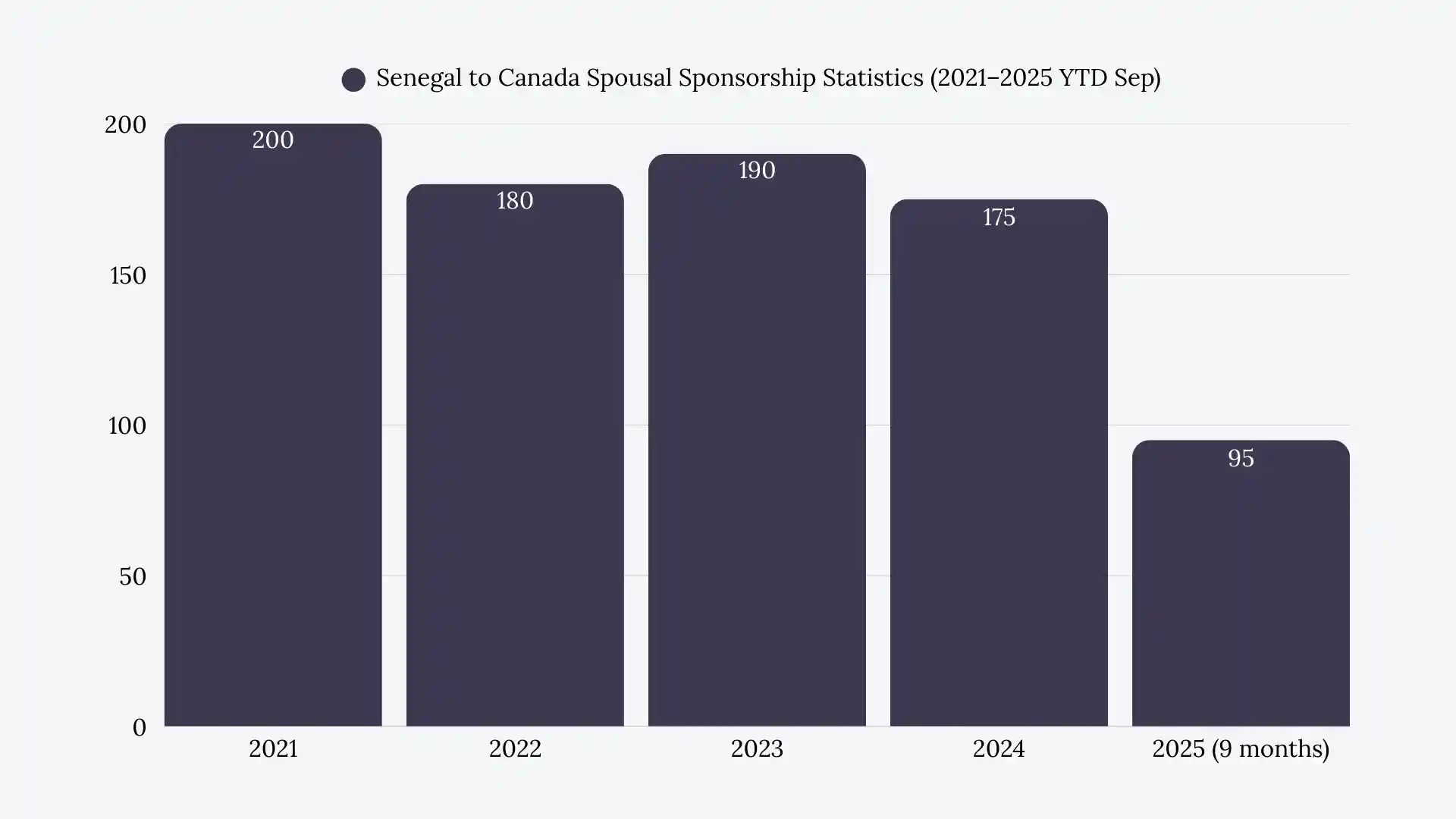
Senegal to Canada Spousal Sponsorship
Last updated:

Are you planning to sponsor your spouse, common-law partner, or conjugal partner from Senegal to Canada? Unlike some countries, Senegal does have extra IRCC requirements: additional mandatory forms for residents and strict rules for late-issued child birth certificates. When these are missed, applications are almost guaranteed to face delays or document re-requests.
Based on IRCC’s Senegal instructions and the most common Senegal-specific pitfalls, here is exactly what you need to prepare to avoid preventable issues.
With Senegal applications, the strongest files are the ones that treat the Senegal add-ons as non-negotiable: IMM 5562 completed for all family members 18+, IMM 5546 and full military booklet copies where applicable, and a complete supporting package for any late-issued child birth certificates, all backed by clear, accurate translations.
Between 2016 and 2025, our Toronto immigration consultants assisted 124 clients from Senegal, so we’ve seen exactly where Senegal-based applications tend to run into trouble—and how to prevent it. If you’d like a full overview of spouse sponsorship Canada, you can just book a consultation with our Canadian immigration representatives. Also, you can check our Immigration Consultant Cost.
Country-Specific Documents
Additional forms for residents
Senegal has extra form requirements that apply across spouse / common-law / conjugal categories:
Supplementary Information – Your Travels (IMM 5562)
- Must be completed by the principal applicant and all family members who are 18 or older included in the application.
- This is required for Senegal, even if your travel history seems simple.
Details of Military Service (IMM 5546)
Complete IMM 5546 for anyone included in the application who has ever:
- held a high-ranking or senior official government position, or
- served in the military, army, defence, or police unit (including National Service)
If IMM 5546 applies, you must also submit:
- a copy of all pages of the military card or booklet, including blank pages
Treat these forms as non-optional for anyone who meets the criteria—missing them is a common trigger for additional document requests.
Senegal – document instructions
For birth certificates issued in Senegal, IRCC has special rules when a child’s birth certificate was not issued at the time of birth. In that case, you must also provide:
- the supplementary judgment
- another official document naming the parents
- school documents listing the parents (or a written explanation if these cannot be obtained)
- the household registry
Submitting only a late-issued birth certificate without this supporting package is one of the most frequent Senegal-specific problems.
The Hidden Hurdle
Late-Issued Birth Certificates
In many Senegal files, the most serious delays come from children whose birth certificates were issued years after birth, with no supporting evidence. Visa officers need to be sure the parental relationship is genuine and properly documented.
To avoid issues:
- Identify any child whose birth certificate was not issued at birth.
- Gather the full set of required supporting documents (supplementary judgment, parental ID evidence, school records, household registry).
- If any element truly can’t be obtained, provide a clear Letter of Explanation describing why, and attach whatever alternative proof you can.
Well-documented late-issued birth certificates are far more likely to be accepted without follow-up.
Translation Requirements
Translations
If any Senegalese document is not in English or French, you must submit:
- the original document, and
- a certified translation that meets IRCC standards
Make sure:
- names, dates of birth, and places are identical between the original and translation
- document numbers and judgment references (for court decisions) are clearly readable and correctly transcribed
Small inconsistencies in spelling or dates can cause unnecessary clarification requests, especially where children or prior marriages are involved.
Biometrics
In most cases, applicants will need to give biometrics (fingerprints and photo) after submitting the application, once IRCC issues a Biometrics Instruction Letter. This step is standard and not specific to Senegal, but you should plan for it as part of your overall timeline.