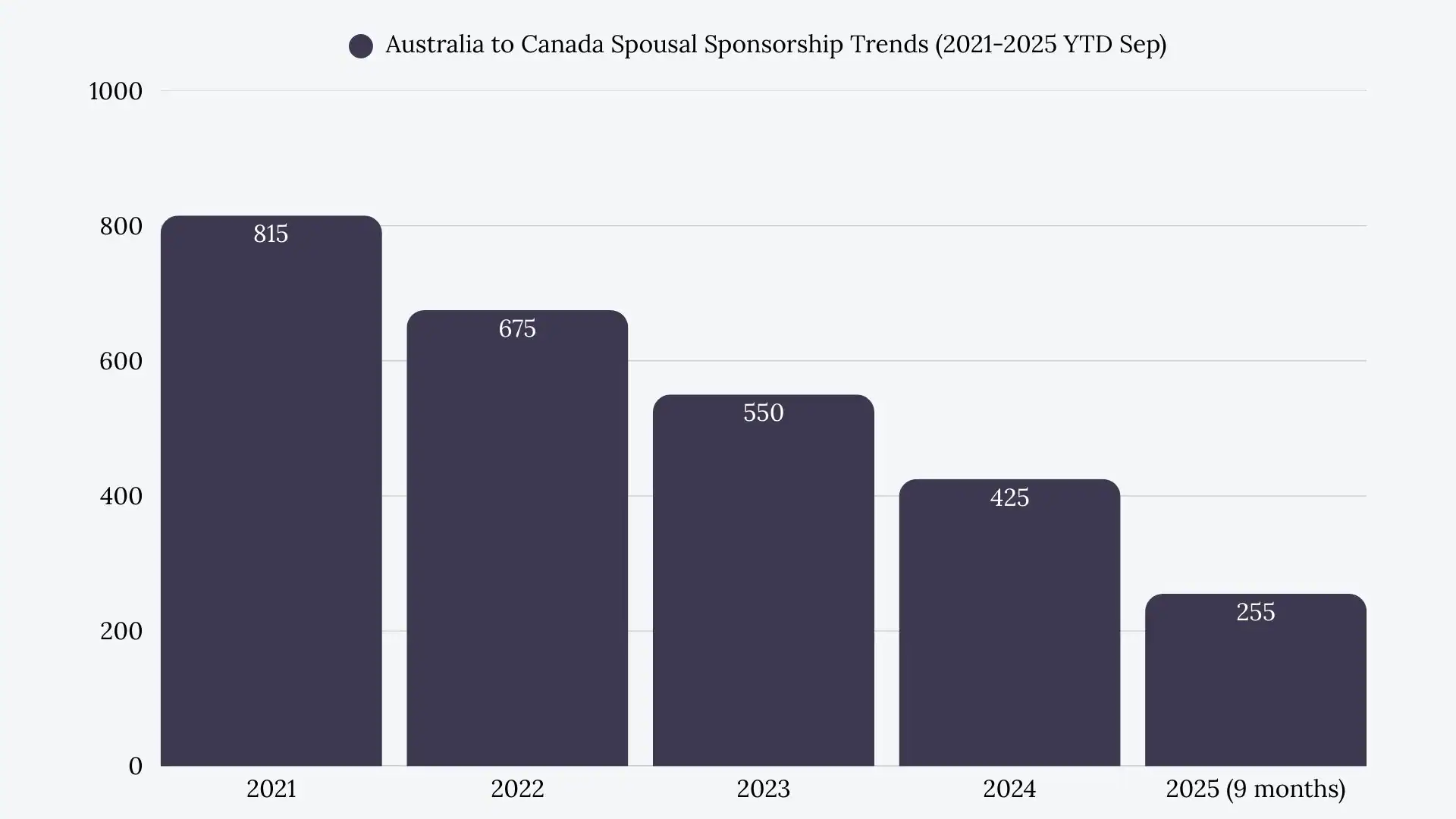
Australia to Canada Spousal Sponsorship
Last updated:

Sponsoring your spouse, common-law partner, or conjugal partner from Australia? You might be relieved that Australia has no “extra” forms. However, the process has two specific “hidden hurdles” related to background checks that catch many applicants off guard.
From 2016 to 2025, we supported 250 clients from Australia through the Canadian immigration process. If you’d like a full overview of Canada spouse sponsorship, you can just book a consultation with our Licensed immigration consultants. Also, you can check our Immigration Consultant Fees.
Country-Specific Documents
If you have lived in Queensland or Victoria, the standard police check is not enough. You must also submit a separate driving record:
- Queensland: You must submit a Traffic History report going back to your 18th birthday (or when you first got a licence). Apply via the Dept. of Transport and Main Roads.
- Victoria: You must submit a Full Licence History Search (going back to age 18). Apply via VicRoads.
- Note: If you never held a licence in these states but lived there, you must get a letter from the roads authority confirming you have “no licence history.”
Required Civil Documents
- Relationship Registration: If you are a Common-Law or De Facto couple, providing a Relationship Registration Certificate (available in most states like NSW, VIC, QLD) is excellent proof of your union, though not strictly mandatory if other evidence is strong.
- Marriage Certificates: Submit the official Registry Issue certificate (BDM), not the ceremonial certificate signed at the wedding day.
Police Certificates (PCC)
Do not use a local state police check (e.g., NSW or VIC Police). IRCC only accepts the Australian Federal Police (AFP) National Police Check.
- Crucial Instruction: When applying online via the AFP website, you must select Code 33 (Immigration/Citizenship).
- Format: IRCC accepts the digital certificate sent by AFP (Code 33 includes “Commonwealth” offences).
Translation Requirements
If any document is not in English or French, include:
- the original document (or required certified copy), plus
- a certified translation
Make sure names, dates, and document details match exactly between the original and the translation.