Move From Philippines to Canada With Licensed Immigration Consultants
Last updated:
Choosing to immigrate to Canada is an important and personal decision. RightWay Canada Immigration Services supports individuals and families in the Philippines who are pursuing permanent residence, study or work opportunities, family reunification or another Canadian immigration pathway. Our role is to make the process clearer, more manageable and carefully prepared from the beginning.
Our team of licensed Canadian immigration consultants is regulated by the College of Immigration and Citizenship Consultants (CICC) and works in accordance with Canadian immigration requirements. Since 2016, RightWay Canada has assisted 372 clients from the Philippines and earned multiple industry recognitions, along with a strong reputation reflected in positive client reviews.
Every immigration case is different. We take the time to understand each applicant’s circumstances and goals, assess the available options and provide clear guidance on eligibility, required documents and the steps ahead. Our support goes beyond completing forms, helping applicants approach the process with greater clarity and confidence. Book a consultation with a licensed immigration consultant to discuss your individual situation. Information about our services and pricing is available on our fees page.
Philippines to Canada Spousal Sponsorship
Applicants applying for spousal sponsorship from the Philippines must follow the country-specific IRCC instructions alongside the standard sponsorship application checklist. These instructions set out the civil-status, identity, and supporting documents that may be required for an application involving Philippine nationals.
For Philippines applicants, the requirements include PSA-issued civil documents, additional identity evidence for late-registered or unregistered births, marital-status documents for Philippine passport holders, and sworn affidavits to explain differences between civil documents. Special rules also apply to PSA-registered births, marriages, or deaths outside the Philippines, as well as minors travelling abroad.
Required IMM
Applicants from the Philippines must follow the IRCC country-specific spousal sponsorship instructions for the Philippines.
The Philippines instructions confirm that there are no extra country-specific forms for residents of the Philippines.
Civil Documents
For civil documents issued in the Philippines, applicants must provide copies issued by the Philippine Statistics Authority, or PSA.
This includes:
- the birth certificate for the principal applicant and all family members included in the application
- the marriage certificate
- the death certificate, if applicable
The officer processing the application may ask for the originals. If originals are requested, they must be printed on PSA paper.
If there are differences between civil documents issued to the principal applicant and any family members, applicants must submit a sworn affidavit explaining the differences.
For a birth, marriage, or death that occurred outside the Philippines, the Philippines-specific instruction depends on whether the event was registered with the PSA.
If the event was registered with the PSA, applicants must submit:
- a copy of the PSA registration document
- a copy of the certificate issued by the country where the event occurred, if one was issued
If the event was not registered with the PSA, applicants must submit a copy of the birth, marriage, or death certificate issued by the country where the event occurred. IRCC may ask to see the original while processing the application.
Family Documents
For birth certificates issued in the Philippines, extra supporting documents are required if:
- the birth was registered late
- there is no record of birth registration with the PSA
A birth is considered late-registered if the registration date on the birth certificate is more than one month after the date of birth. The registration date is the date the Office of Local Civil Registrar received the birth certificate.
In these situations, applicants must include another proof of identity, such as copies of:
- the baptismal certificate
- the hospital or medical birth record
- permanent elementary and high school records
- old passports
- the birth certificate issued by the Local Civil Registrar
Marriage Documents
If the principal applicant holds a Philippine passport, the principal applicant and family members included in the application must follow the Philippines-specific marital-status instructions.
To prove the principal applicant’s marital status, applicants must submit copies of one of the following:
- Certificate of No Marriage Record, or CENOMAR, showing there is no record of marriage
- PSA Advisory on Marriages showing details of any marriages registered in the Philippines
Children’s Documents
For Philippine nationals and residents travelling with minors, the principal applicant or sponsor must make sure the Philippine government’s travel requirements for minors travelling abroad are met.

Philippines to Canada Citizenship by Descent
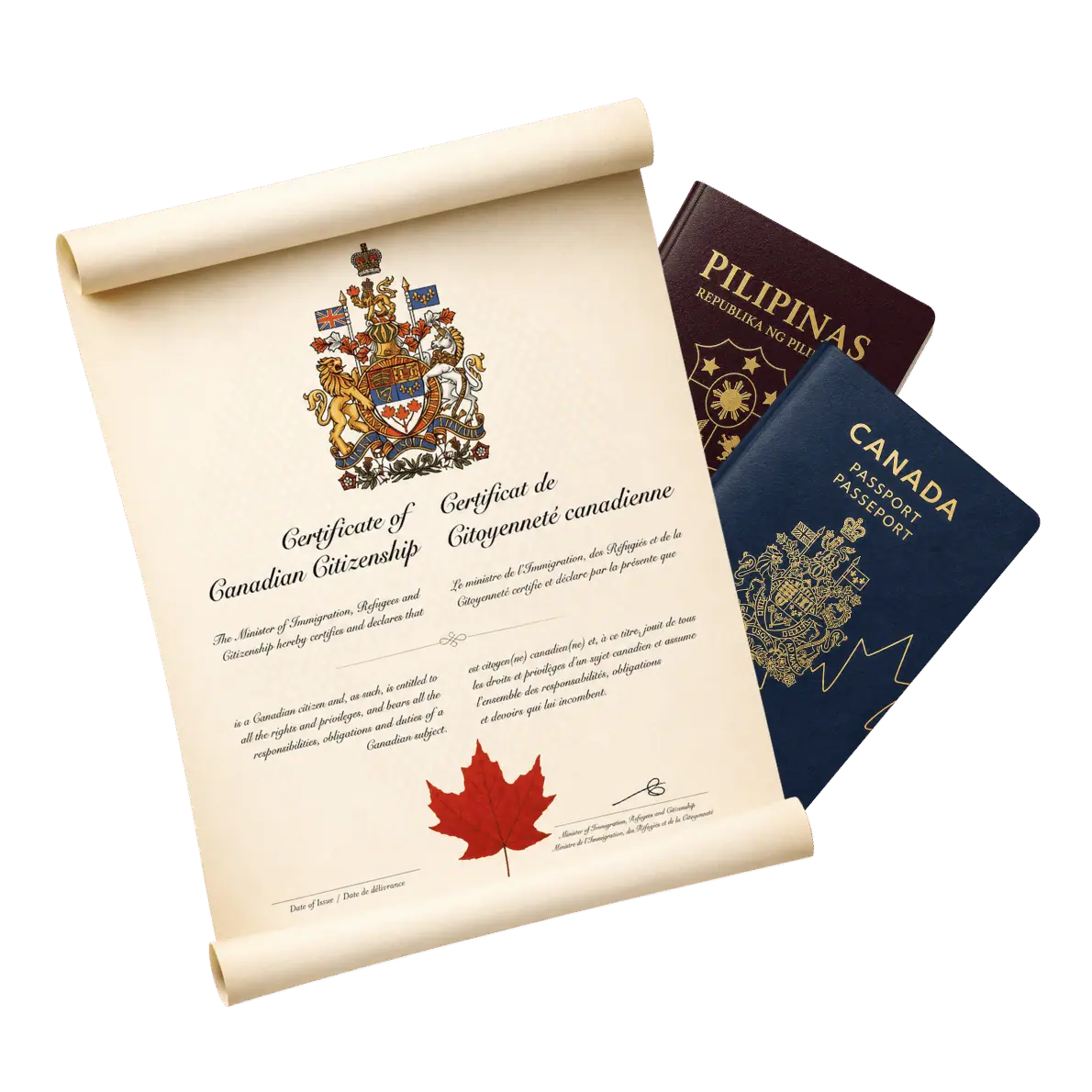
A person born in the Philippines may already have Canadian citizenship by descent if at least one parent was a Canadian citizen at the time of their birth. This can happen in families where a Canadian parent lived in the Philippines for work, education, business, marriage, family responsibilities, or long-term residence before having children.
Canada and the Philippines have strong people-to-people connections shaped by migration, caregiving, education, work, and family ties. For some Philippines-born children and adults, those connections may be more than personal history; they may include a legal connection to Canada through a Canadian parent.
In these cases, the person is usually not applying to become Canadian. They are applying for a Canadian citizenship certificate to prove citizenship they may already have. This certificate can be important for a Canadian passport, future relocation to Canada, children’s citizenship questions, or family situations where Bill C-3 has made an older Canadian connection worth reviewing again.
Philippines to Canada Express Entry
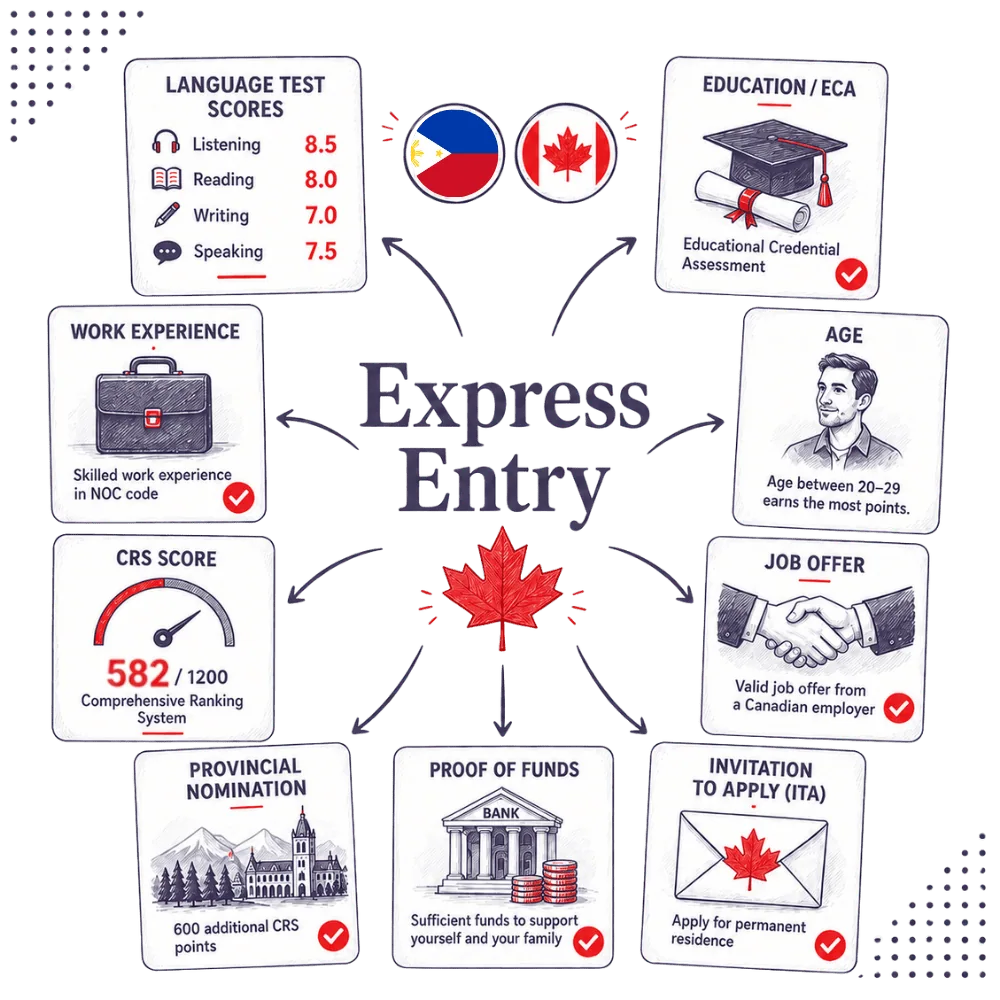
The Philippines is a well-established source country for permanent residence through Canada’s Express Entry system. From 2021 to the first quarter of 2026, IRCC data shows 16,540 admissions of permanent residents under Express Entry for the Philippines, reflecting the pathway’s continued relevance for Filipino skilled workers pursuing long-term settlement in Canada.
For applicants from the Philippines, strong English-language ability, recognized education, and well-documented skilled work experience can be important advantages. An Educational Credential Assessment, approved language test results, accurate employment records, and proof of funds where required help support a complete and credible profile.
A Philippines-focused Express Entry plan should look beyond basic eligibility and assess how the applicant’s occupation, CRS score, education, work history, and provincial nomination options fit together. Careful preparation can help Filipino applicants understand their competitiveness, address weak points early, and prepare a stronger permanent residence application.
Philippines to Canada PNP
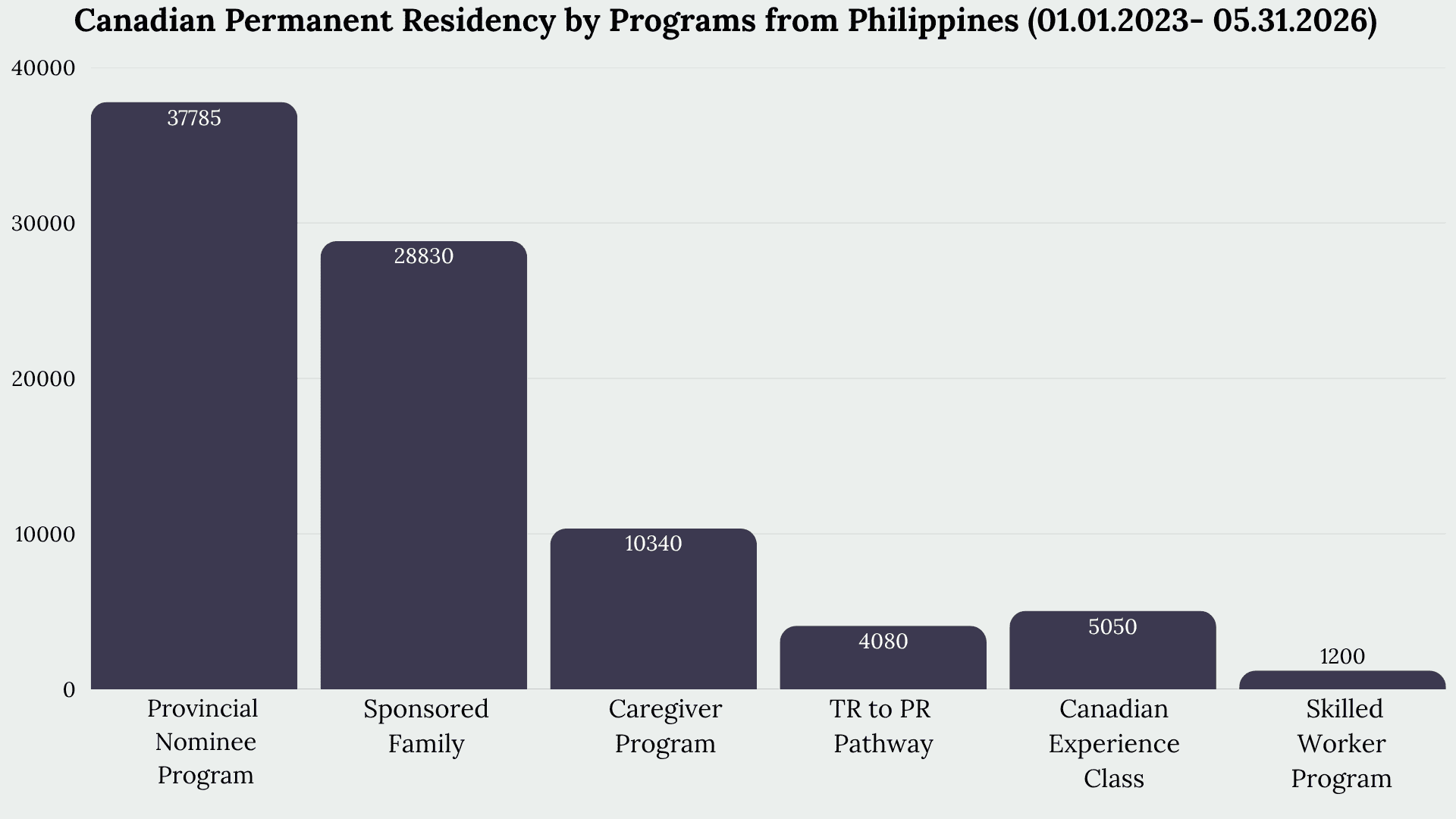
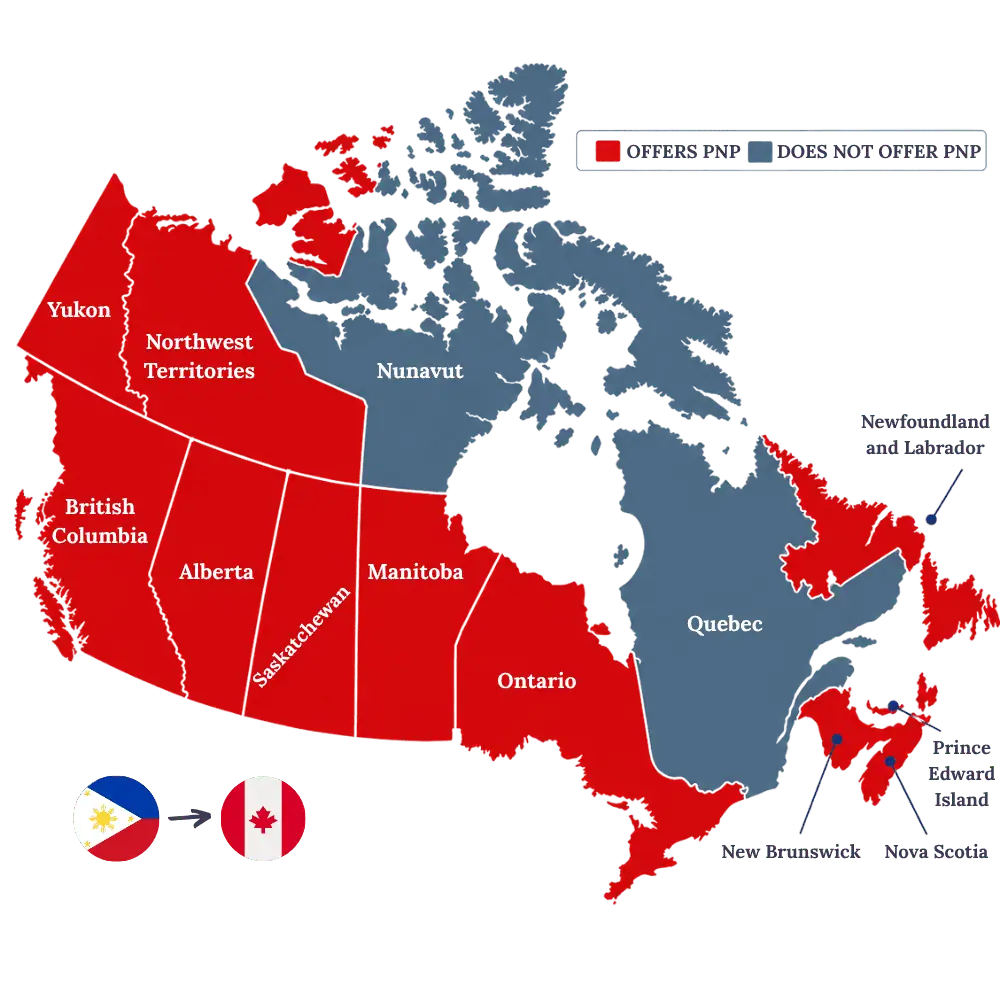
The Philippines is a strong source country for permanent residence through Canada’s Provincial Nominee Program. PNP pathways allow Canadian provinces and territories to nominate skilled workers whose education, occupation, work experience, language ability, and settlement plans match local labour market needs.
For applicants in the Philippines, success through a PNP depends on choosing the right provincial pathway and preparing documents that support the stream’s requirements. Depending on the province, candidates may need skilled work experience, language test results, education credentials, an eligible occupation, a job offer, previous study or work experience in the province, or another connection that supports their intent to settle there.
A Philippines-focused PNP strategy should compare provincial options based on the applicant’s occupation, education, work history, language scores, job offer potential, and long-term settlement goals. With the right preparation, applicants from the Philippines can identify suitable nomination opportunities and approach the provincial nomination process with greater clarity and confidence.
Philippines to Canada Study Permit
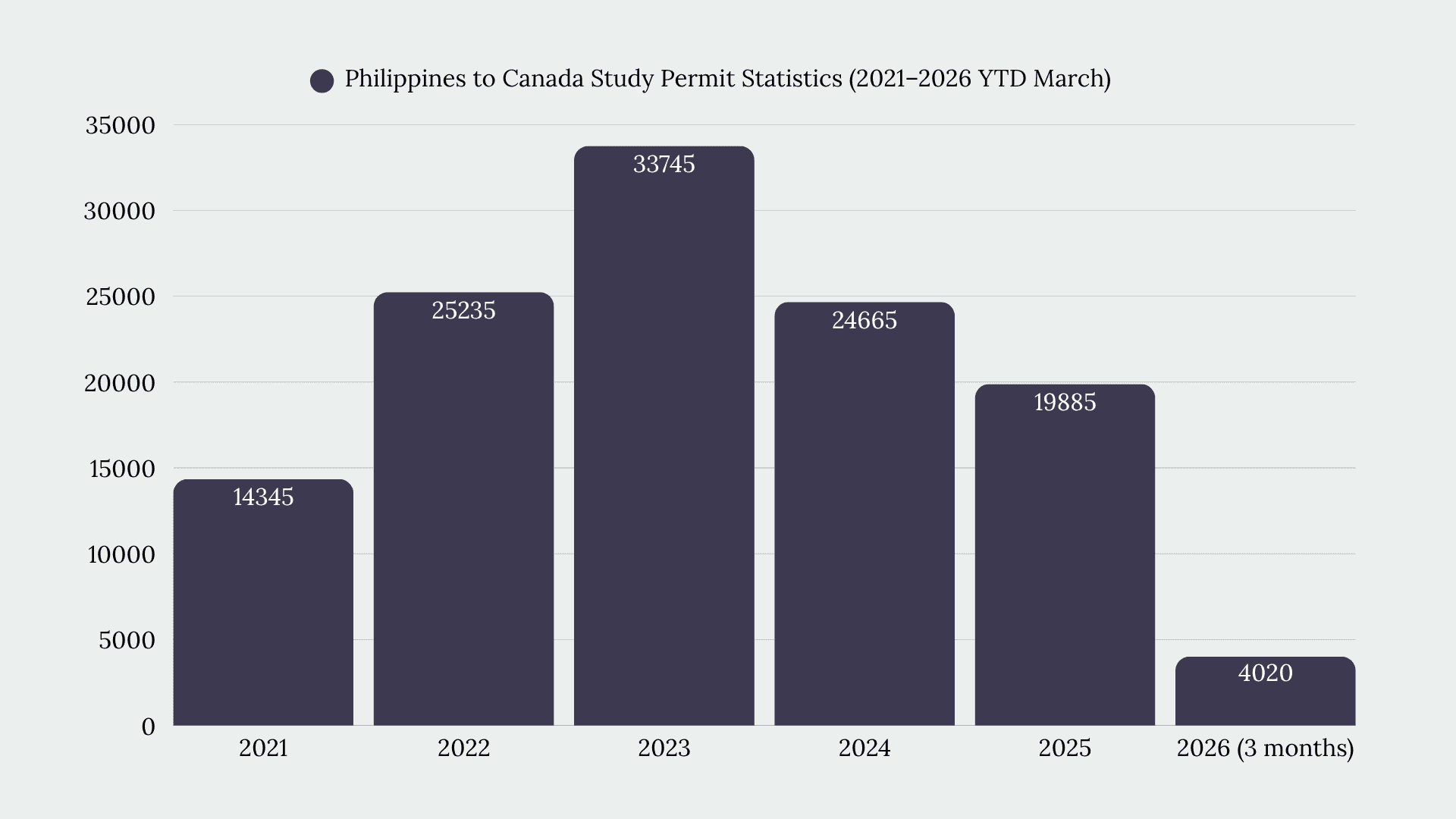
Applicants applying for a Canada study permit from the Philippines must follow the Manila visa office instructions for local document requirements. These instructions are listed in the Manila Visa Office Additional Document Checklist — IMM 5836, which is used together with the standard Canada study permit checklist.
For Philippines applicants, IMM 5836 focuses on passport and residence-status documents, a personal study plan, current and past education records, financial documents showing how the studies will be funded, and specific NBI certificate instructions for applicants aged 18 or older.
Required Forms
Philippines study permit applicants must follow the Manila Visa Office Additional Document Checklist for study permits.
Country-specific checklist:
IMM 5836 is used alongside the standard study permit checklist. It does not replace the general study permit requirements.
Applicants should also provide the passport documents required under IMM 5836. Applicants who do not live in their country of citizenship should include proof of their legal status in their current country of residence.
Study Plan and Records
Philippines study permit applicants should provide a personal study plan explaining how the proposed program relates to their academic, technical or vocational background and future career goals.
Applicants should also include an official fee schedule showing:
- tuition fees;
- accommodation and meal-plan costs; and
- miscellaneous expenses, such as medical insurance, books and memberships.
The application should also include evidence of the applicant’s current and previous education, such as:
- copies of diplomas and certificates;
- proof of ongoing enrolment, where applicable;
- post-secondary transcripts; and
- any other current academic transcripts.
Financial Evidence
Philippines study permit applicants should provide detailed evidence showing how their studies will be funded.
Applicants may provide financial documents belonging to themselves, their spouse or their parents, including:
- bank records covering the previous six months, such as bank books and statements;
- fixed-deposit records;
- income tax documents;
- employment reference letters confirming earnings; and
- evidence of self-employment or business income.
When another person is helping to fund the applicant’s studies, the application should include:
- a letter explaining why the person is providing financial support;
- proof of the relationship, where applicable;
- the supporter’s bank records covering the previous six months or evidence of fixed deposits;
- the supporter’s income tax documents; and
- employment reference letters or evidence of self-employment or business income.
Applicants who have received a scholarship, financial assistance or an award from an educational institution, government or other funding agency should provide an official letter confirming the full amount of the funding, its duration and any applicable conditions.
Applicants who have already paid part of their tuition fees should also include proof of payment.
Police Certificates
Philippines study permit applicants who are 18 years of age or older should provide an original National Bureau of Investigation certificate, commonly known as an NBI certificate.
The certificate must:
- have been issued within the previous three months;
- bear a dry seal and thumbprint; and
- be an original document, as personal copies are not accepted.
If the NBI certificate contains remarks such as “No Criminal Record,” “No Pending Case” or “With Derogatory Record,” the applicant may also need to provide:
- a written explanation from the NBI;
- court documents relating to the case or charge; and
- a written statement explaining the circumstances.

Philippines to Canada Super Visa
Applicants applying for a Canada Super Visa from the Philippines must follow the Manila visa office instructions – IMM 5877, in addition to the standard Super Visa checklist.
For Philippines applicants, IMM 5877 includes Super Visa-specific instructions on the invitation letter from a child or grandchild in Canada, proof of the inviter’s income and Canadian status, proof of the parent or grandparent relationship, and medical insurance.
Financial Support
Applicants from the Philippines are assigned to the Manila Visa Office Instructions:
For a Parents and Grandparents Super Visa, IMM 5877 requires a letter of invitation from the applicant’s child or grandchild residing in Canada.
IMM 5877 also requires one of the following documents to prove that the applicant’s child or grandchild meets the Low Income Cut-Off, or LICO, minimum:
- most recent copy of the Notice of Assessment
- most recent copy of the T4 or T1
If the child or grandchild does not have a paper copy of the Notice of Assessment, they can view and print tax returns and other personal tax information through the Canada Revenue Agency’s My Account online service.
Relationship & Status
IMM 5877 requires proof of the applicant’s parental relationship to their child or grandchild.
This may include:
- A copy of a birth certificate.
- Another official document naming the applicant as the parent.
IMM 5877 also requires proof that the applicant’s child or grandchild is a Canadian citizen or permanent resident.
Medical Insurance
IMM 5877 requires proof of medical insurance from a Canadian insurance company.
The insurance must provide:
- Minimum coverage of $100,000.
- Coverage for one year.
Applicants should provide a copy of the insurance certificate or policy.

Philippines to Canada Visitor Visa
Applicants applying for a Canada visitor visa from the Philippines may need to follow the Manila visa office instructions in addition to the standard temporary resident visa checklist. These instructions are listed in the Manila Visa Office Instructions — IMM 5877.
For Philippine applicants, IMM 5877 includes POEA exit permission and a letter from a local manning agency for seafarers.
Visa Office Instructions
Philippines visitor visa applicants may need to follow the Manila Visa Office Instructions in addition to the standard temporary resident visa requirements.
Relevant visa office instructions:
IMM 5877 includes additional instructions concerning financial and employment evidence, seafarer documents and applicants returning to Canada to continue their studies or work.
Financial and Employment Evidence
Applicants should provide financial and occupational documents that match their circumstances.
Applicants who qualify under CAN+ may not need to provide financial evidence when they submit proof of qualifying previous travel to Canada or a valid United States non-immigrant visa.
Other visitors should provide:
- personal bank statements covering the previous six months;
- recent pay slips or other proof of income; and
- documents showing savings, investments, property or other assets.
If another person is paying for the visit, the application should include:
- a signed letter confirming the financial support;
- evidence that the person has sufficient funds;
- an explanation of the relationship between the applicant and the person providing support; and
- details of the expenses that will be covered.
The financial support documents should be dated within three months of the application.
Employed applicants should provide a recent employer letter confirming their position, salary, length of employment and approved leave. Self-employed applicants should provide business registration and financial records.
Seafarer Documents
Seafarers travelling to Canada to join a vessel should provide:
- a valid seafarer’s booklet and competency certificate;
- a POEA exit permission certificate;
- a copy of the employment contract;
- a letter from the local manning agency confirming the vessel’s name, Canadian port and expected joining date; and
- a letter from the Canadian shipping company or manning agency confirming the employment and vessel-joining arrangements.
Returning Students and Workers
Applicants returning to Canada to continue their studies should provide:
- a copy of their valid Canadian study permit; and
- a recent letter from their educational institution confirming current enrolment and the date they are expected to resume their studies.
Applicants returning to Canada to continue working should provide:
- a copy of their valid Canadian work permit; and
- a recent letter from their Canadian employer confirming that they are expected to return and resume their employment.