Move From Nigeria to Canada With Licensed Immigration Consultants
Last updated:

Choosing to immigrate to Canada is an important and personal decision. RightWay Canada Immigration Services supports individuals and families in Nigeria who are pursuing permanent residence, study or work opportunities, family reunification or another Canadian immigration pathway. Our role is to make the process clearer, more manageable and carefully prepared from the beginning.
Our team of licensed Canadian immigration consultants is regulated by the College of Immigration and Citizenship Consultants (CICC) and works in accordance with Canadian immigration requirements. Since 2016, RightWay Canada has assisted 1,383 clients from Nigeria and earned multiple industry recognitions, along with a strong reputation reflected in positive client reviews.
Every immigration case is different. We take the time to understand each applicant’s circumstances and goals, assess the available options and provide clear guidance on eligibility, required documents and the steps ahead. Our support goes beyond completing forms, helping applicants approach the process with greater clarity and confidence. Book a consultation with a licensed immigration consultant to discuss your individual situation. Information about our services and pricing is available on our fees page.

Nigeria to Canada Spousal Sponsorship
Applicants applying for spousal sponsorship from Nigeria must follow the country-specific IRCC instructions alongside the standard sponsorship application checklist. These instructions identify additional forms and supporting documents that may be required for an application involving Nigerian nationals.
For Nigeria applicants, the requirements include IMM 5562 for travel history and IMM 5546 for certain applicants with a senior government, military, defence, police, or National Service history. Copies of military cards or booklets may also be required, along with supporting documents when a child’s Nigerian birth certificate was not issued at the time of birth.
Required Forms
Applicants from Nigeria must complete the following country-specific forms where applicable:
- Supplementary Information – Your Travels [IMM 5562]
- Required for the principal applicant.
- Required for all family members included in the application who are 18 years old or older.
- Details of Military Service [IMM 5546]
- Required for anyone included in the application who has ever:
- held a high-ranking or senior official government position, or
- served in the military, army, defence, or police unit, including National Service.
- Required for anyone included in the application who has ever:
If IMM 5546 applies, submit a copy of all pages of the person’s military card or booklet, including blank pages.
Children’s Documents
If a child’s birth certificate issued by Nigeria was not issued at the time of birth, submit copies of:
- the supplementary judgment
- another official document naming the parents
- school documents listing the parents, if available
- the household registry
If school documents listing the parents cannot be obtained, provide an explanation.

Nigeria to Canada Express Entry
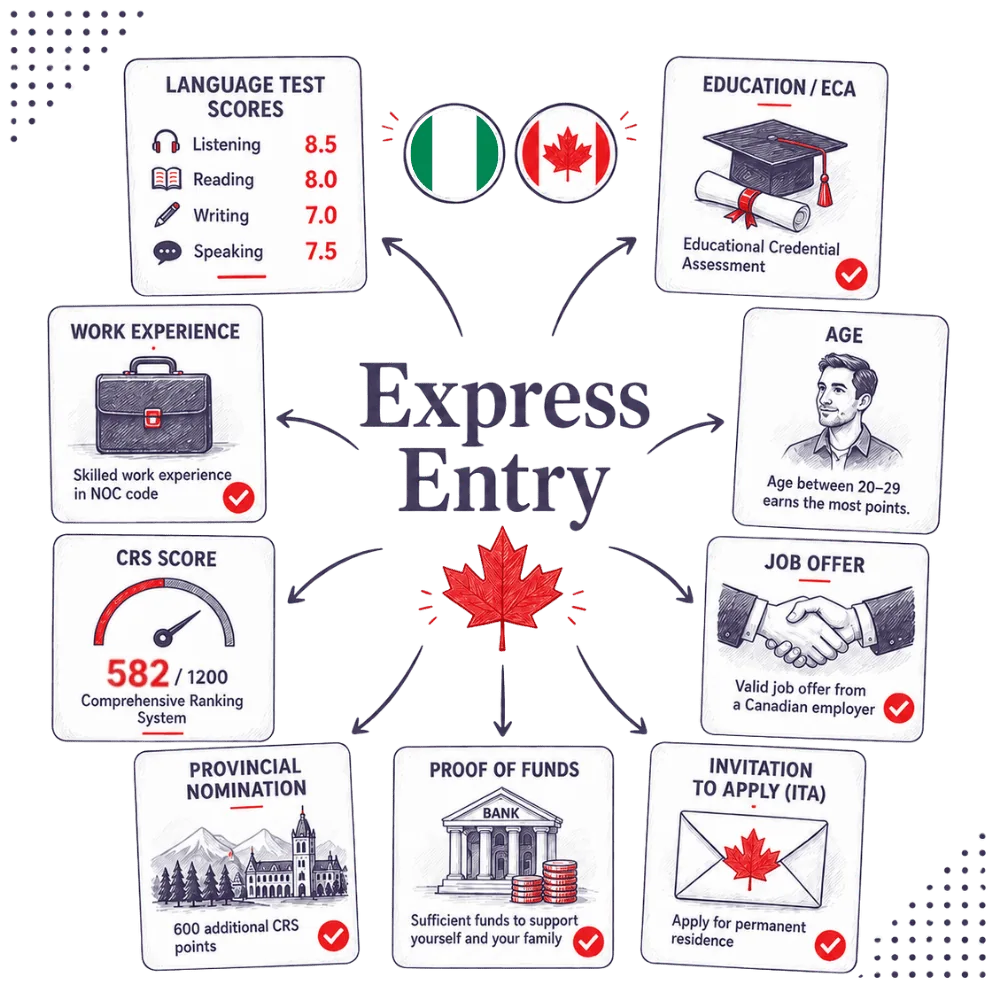
Nigeria is one of the key African source countries for permanent residence through Canada’s Express Entry system. From 2021 to the first quarter of 2026, IRCC data shows 52,915 admissions of permanent residents under Express Entry for Nigeria, showing the strong role this pathway plays for Nigerian professionals and skilled workers planning to settle in Canada.
For applicants from Nigeria, profile strength often depends on the consistency of education, work experience, and language documentation. An Educational Credential Assessment, approved English or French language test results, accurate employment history, and proof of funds where required can all affect both CRS competitiveness and application readiness. In a competitive pool, incomplete or inconsistent documents can weaken an otherwise strong case.
A Nigeria-focused Express Entry strategy should assess how the applicant’s occupation, education, work experience, CRS score, and possible provincial nomination options work together. Strong preparation helps applicants understand where they stand, improve what can be improved, and move forward with a clearer permanent residence plan.
Nigeria to Canada PNP
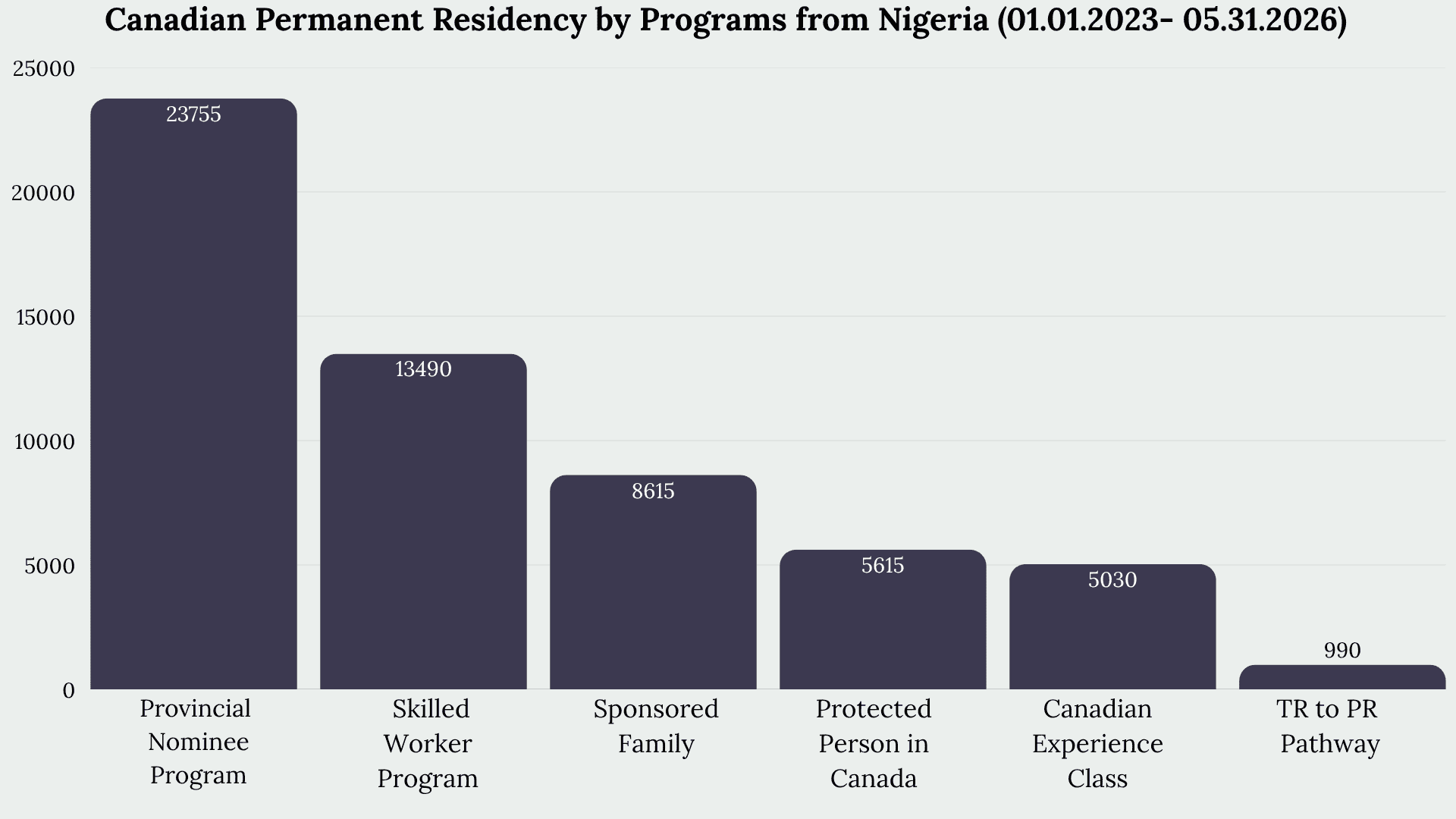
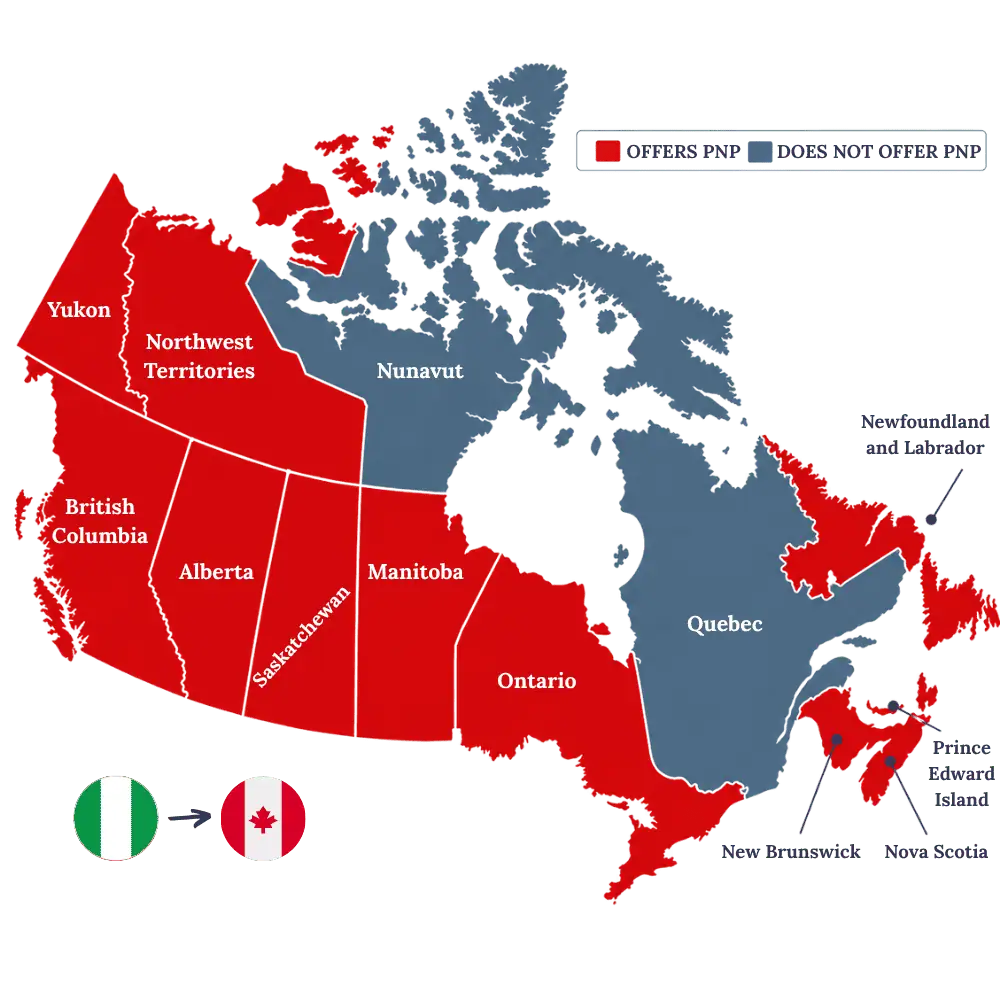
Nigeria is a strong source country for permanent residence through Canada’s Provincial Nominee Program. PNP pathways allow Canadian provinces and territories to nominate skilled workers whose education, occupation, work experience, language ability, and settlement plans align with local labour market needs.
For applicants in Nigeria, success through a PNP depends on identifying the right provincial pathway and preparing documents that support the stream’s requirements. Depending on the province, candidates may need skilled work experience, language test results, education credentials, an eligible occupation, a job offer, previous study or work experience in the province, or another connection that supports their intent to settle there.
A Nigeria-focused PNP strategy should compare provincial options based on the applicant’s occupation, education, work history, language scores, job offer potential, and long-term settlement goals. With the right preparation, applicants from Nigeria can identify suitable nomination opportunities and approach the provincial nomination process with greater clarity and confidence.
Nigeria to Canada Study Permit
Applicants applying for a Canada study permit from Nigeria must follow the Lagos visa office instructions for local document requirements. These instructions are listed in the Lagos Visa Office Additional Document Checklist — IMM 5832, which is used together with the standard Canada study permit checklist.
For Nigeria applicants, IMM 5832 focuses on academic records, previous passports showing travel history, financial documents, sponsor evidence, and scholarship or funding documents where applicable.
Required Forms
Nigeria study permit applicants must follow the Lagos Visa Office Additional Document Checklist for study permits.
Country-specific checklist:
IMM 5832 is used alongside the standard study permit checklist. It does not replace the general study permit requirements.
Applicants should also include any previous passports showing their travel history, where available.
Academic Records
Nigeria study permit applicants should provide documents confirming their current and previous education.
Academic records may include:
- up-to-date transcripts showing the applicant’s current academic standing;
- WAEC, SSCE or NECO results;
- post-secondary transcripts;
- certificates and diplomas;
- the street name and full address of every educational institution previously attended; and
- an NYSC certificate, where applicable.
These documents help establish the applicant’s education history and support the study permit application.
Financial Evidence
Nigeria study permit applicants should provide evidence that they meet IRCC’s current financial requirements for their proposed studies in Canada.
Financial evidence may include:
- certified bank statements or financial investment records covering the previous six months, including the month of submission or ending no more than one month before submission;
- a MyBankStatement ticket from the financial institution, where available, including the ticket ID and passcode; and
- documents showing that the funds come from a reliable source and will remain available for the duration of the academic program.
When a sponsor is supporting the applicant, the application should include evidence of the sponsor’s financial capacity. This may include:
- employment confirmation;
- pay slips;
- salary bank statements;
- pension plan documents;
- proof of rental income; and
- stocks, bonds or similar financial records.
If the funds are being provided by someone other than the applicant or an immediate family member, such as a parent or spouse, the application should also include proof of the relationship and an explanation of how that person will provide financial support.
When the source of funds is a business, applicants should provide official business registration documents and evidence showing ownership of the business.
Applicants who have received a scholarship or other financial assistance from an educational institution, government or funding agency should provide an official letter confirming the full amount of the funding, its duration and any applicable conditions. The application should also include evidence that the scholarship program exists.

Nigeria to Canada Super Visa
Applicants applying for a Canada Super Visa from Nigeria must follow the Lagos visa office instructions in addition to the standard Super Visa checklist. These instructions are listed in the Lagos Visa Office Instructions — IMM 5873.
For Nigeria applicants, IMM 5873 includes Super Visa-specific instructions on private medical insurance, a written invitation promising financial support, proof of the inviter’s status in Canada, and Canadian-source evidence of the inviter’s ability to provide financial support.
Medical Insurance
Applicants from Nigeria are assigned to the Lagos visa office instructions:
For a Parents and Grandparents Super Visa, IMM 5873 requires proof of private medical insurance.
The insurance must be valid for at least 1 year from a Canadian insurance company and must:
- cover health care, hospitalization, and repatriation
- provide minimum coverage of $100,000
- be valid for each entry to Canada
- be available for review by a port of entry officer
Invitation Letter
Applicants must provide a written and signed invitation letter from their inviter in Canada.
The invitation letter must promise financial support for the duration of the applicant’s visit.
Inviter Status
Applicants must include a copy of the inviter’s citizenship or immigration status document.
If the inviter is a permanent resident, IMM 5873 specifies that both sides of the Permanent Resident Card should be copied.
Financial Support
Applicants must provide proof that the inviter can provide the promised financial support.
IMM 5873 requires independent, third-party documentation from a Canadian source that is reliable or easily verifiable.
Examples include:
- Canada Revenue Agency Notice of Assessment
- employment letters showing salary
- pay stubs
- bank statements
- Statements of Remuneration Paid
- financial statements prepared by a licensed professional

Nigeria to Canada Visitor Visa
Applicants applying for a Canada visitor visa from Nigeria may need to follow the Lagos visa office instructions in addition to the standard temporary resident visa checklist. These instructions are listed in the Lagos Visa Office Instructions — IMM 5873.
For Nigeria applicants, IMM 5873 includes a consent-to-verification form and supporting documentation for official travel issued through the Federal Ministry of Foreign Affairs or an embassy.
Visa Office Instructions and Official Passport Holders
Applicants from Nigeria should follow the Lagos Visa Office Instructions together with the standard IRCC temporary resident visa requirements.
Relevant visa office instruction:
Applicants must also complete and submit the Consent to Verification of Documents form included in the Lagos visa office instructions.
Diplomatic and official passport holders should provide an original Note Verbale from the Federal Ministry of Foreign Affairs or their embassy stating the purpose of travel to Canada, together with an invitation from the Canadian host.
Financial and Occupational Evidence
Applicants who do not qualify under CAN+ should provide personal bank statements covering the previous three months.
If another person is paying for the trip, supporting financial documents should be dated within the previous three months and may include a support letter, bank statements and evidence of the person’s employment or income.
Employees should provide:
- pay slips covering the previous three months; and
- an employer letter dated within the previous two months confirming their position, salary, length of employment and approved leave.
Self-employed applicants should provide evidence of their business activities, including a certified business bank statement covering the previous six months and relevant business registration documents.
Applicants who qualify under CAN+ do not need to provide proof of financial support.
Business and Event Travel
Applicants travelling to Canada for business should provide:
- a letter from their employer confirming the purpose and duration of the trip, their position and salary, and who will pay the travel costs; and
- a letter from the Canadian business or organization they will visit confirming the purpose and duration of the visit and providing contact details.
Applicants travelling for a seminar, trade show or conference should provide:
- an invitation from the Canadian organization;
- proof of registration;
- hotel confirmation; and
- an employer letter confirming the purpose and duration of the trip and who will cover the expenses.
Children and Family Documents
Applicants travelling with family members should provide marriage and birth certificates, as applicable.
Children should have their own passports and, where relevant, a letter from their school confirming authorized leave.
A child travelling alone or with only one parent should also provide:
- a birth certificate;
- a consent letter from the non-accompanying parent or parents; and
- a copy of the identification document of the parent or parents providing consent.
Additional custody or guardianship documents should be provided where applicable.