
Move From Malawi to Canada With Licensed Immigration Consultants
Last updated:
Choosing to immigrate to Canada is an important and personal decision. RightWay Canada Immigration Services supports individuals and families in Malawi who are pursuing permanent residence, study or work opportunities, family reunification or another Canadian immigration pathway. Our role is to make the process clearer, more manageable and carefully prepared from the beginning.
Our team of licensed Canadian immigration consultants is regulated by the College of Immigration and Citizenship Consultants (CICC) and works in accordance with Canadian immigration requirements. Since 2016, RightWay Canada has assisted 55 clients from Malawi and earned multiple industry recognitions, along with a strong reputation reflected in positive client reviews.
Every immigration case is different. We take the time to understand each applicant’s circumstances and goals, assess the available options and provide clear guidance on eligibility, required documents and the steps ahead. Our support goes beyond completing forms, helping applicants approach the process with greater clarity and confidence. Book a consultation with a licensed immigration consultant to discuss your individual situation. Information about our services and pricing is available on our fees page.
Malawi to Canada Spousal Sponsorship
Applicants from Malawi do not have additional Malawi-specific IRCC forms or special country-specific document requirements for spousal sponsorship. Applications should therefore follow the standard IRCC spousal sponsorship instructions and document checklist, with careful attention to complete identity and civil-status documents, required translations and clear evidence supporting the relationship.
Canada’s spousal sponsorship program allows eligible Canadian citizens and permanent residents to sponsor a spouse, common-law partner or conjugal partner for permanent residence. IRCC assesses the sponsor’s eligibility, the genuineness of the relationship and the sponsored applicant’s admissibility before making a final decision.
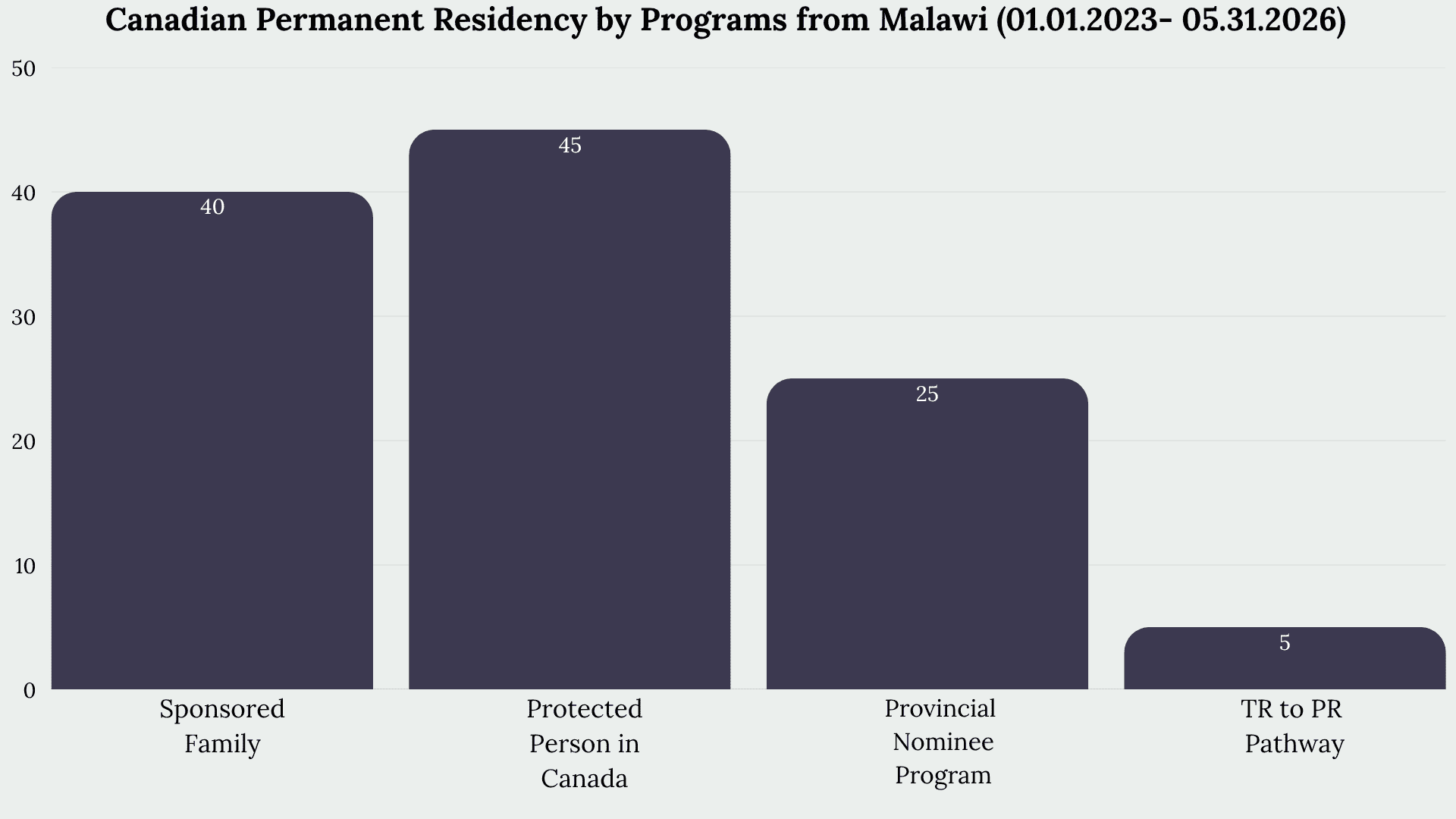
IRCC permanent residence statistics show that 40 Malawian citizens were admitted to Canada as sponsored spouses or partners from 2023 through May 2026. This included 10 admissions in 2023, 20 in 2024 and 10 in 2025, with no admissions recorded from January to May 2026.

Malawi to Canada Study Permit
Applicants applying for a Canada study permit from Malawi must follow the Pretoria visa office instructions for local document requirements. These instructions are listed in the Pretoria Visa Office Additional Document Checklist — IMM 5845, which is used together with the standard Canada study permit checklist.
For Malawi applicants, IMM 5845 focuses on the study plan, current and previous study records, financial evidence, sponsor documents, and proof that the applicant has a reliable source of funds for at least one year of study in Canada.
Required Forms
Malawi study permit applicants must follow the Pretoria Visa Office Additional Document Checklist for study permits.
Country-specific checklist:
IMM 5845 is used alongside the standard study permit checklist. It does not replace the general study permit requirements.
Study Plan and Academic Records
Malawi study permit applicants must provide a one-page study plan explaining the purpose of their proposed studies in Canada and how the program fits their educational background and future plans.
The study plan should explain:
- why the applicant wants to study in Canada in the program to which they have been accepted;
- the applicant’s overall educational goal;
- why they are not pursuing a similar program in their country of residence;
- what research they have conducted into available study options in their country of residence or citizenship;
- how the proposed Canadian program may improve their employment opportunities in their country of residence or citizenship; and
- the ties they have to their country of residence or citizenship.
Applicants who have been out of full-time education for more than two years should also provide a CV or resumé.
For a minor applicant, the study plan should explain the reasons for studying in Canada and include information about the immigration status of the applicant’s parents or guardians in their current country of residence.
Applicants should also provide documents confirming their current and previous education, including:
- transcripts from the educational institution they are currently attending;
- copies of their high school certificates or diplomas; and
- documents relating to any post-secondary studies they have completed or are currently pursuing.
Financial Evidence
Malawi study permit applicants should provide evidence that they have sufficient funds to cover tuition and living expenses for at least one year in Canada. The application should also include documents showing that the funds come from a reliable source and can be converted to Canadian dollars.
Financial evidence may include:
- a letter of undertaking and recent bank statements from a parent or sponsor;
- an official scholarship or financial award letter;
- investment documents, where applicable; and
- proof of tuition payment or funding from the Canadian educational institution, where applicable.
Deeds, property ownership documents and vehicle ownership documents are not accepted as proof of funds.
When a third party is sponsoring the applicant’s studies, the application should include:
- the sponsor’s bank statements;
- the sponsor’s employment records;
- a letter containing the sponsor’s current contact information and explaining why they are financing the applicant’s studies; and
- proof of the relationship, if the sponsor is a relative, such as birth certificates.
If the third-party sponsor lives in Canada, the application should also include:
- the sponsor’s name, address, telephone number and email address;
- proof of the sponsor’s legal status in Canada, such as evidence of Canadian citizenship, permanent resident status, a study permit or a work permit;
- proof of employment showing the sponsor’s length of service and salary;
- a bank statement; and
- the summary page of the sponsor’s most recent Canada Revenue Agency Notice of Assessment.

Malawi to Canada Visitor Visa
Applicants applying for a Canada visitor visa from Malawi may need to follow the Pretoria visa office instructions in addition to the standard temporary resident visa checklist. These instructions are listed in the Pretoria Visa Office Instructions — IMM 5971.
For Malawi applicants, IMM 5971 includes a Consent to Verification of Documents form.
Visa Office Instructions
Applicants from Malawi should follow the Pretoria Visa Office Instructions together with the standard IRCC temporary resident visa requirements.
Relevant visa office instruction:
Applicants must also complete and submit the Consent to Verification of Documents form included in the Pretoria visa office instructions.
Financial and Occupational Evidence
Applicants who do not qualify under CAN+ should provide evidence that they have sufficient funds for the visit.
Relevant supporting documents may include:
- an employment letter;
- pay slips covering the previous three months;
- proof of pension income;
- business registration documents; and
- evidence of investments or other available funds.
If another person is paying for the trip, the application should include a signed support letter, proof of that person’s identity and finances, an explanation of their relationship to the applicant, and details of the expenses they will cover.
Employed applicants should provide a letter confirming their position, salary, length of employment, approved leave and expected return-to-work date.
Self-employed applicants should provide business registration or licensing documents and evidence of the business’s financial activity.
Business, Conference and Official Visits
Applicants travelling to Canada for business should provide:
- business registration and financial records; and
- an official invitation from their Canadian business contacts confirming the purpose and duration of the visit, contact details and funding arrangements.
Applicants travelling for a conference or training should provide:
- an invitation or registration confirmation from the Canadian organizer;
- a current employer letter explaining the purpose and duration of the trip; and
- evidence showing who will pay the travel and related expenses.
Applicants travelling on official government business should provide a Mission Order or Verbal Note describing the purpose and duration of the visit and identifying the organization responsible for the expenses.